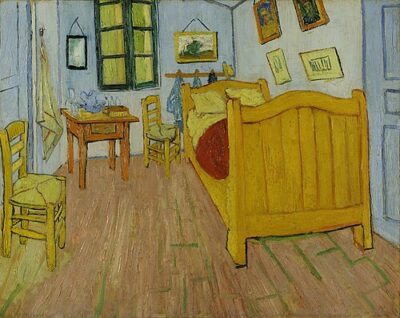
Bedroom in Arles
Bedroom in Arles is a series of three similar paintings by Vincent van Gogh. It came out in 1888.
- Came out
- October 1888
- Created by
- Vincent van Gogh
All 3 facts, and where they come from
Facts
3 facts · 0 confirmed by two sources · 0 cited · 3 from one source
Where this comes from
Papalocal keeps its own record. It started from these sources; what each one said is kept here as it was copied, so a change on their side never changes this page by itself. Tap one to read its version.
What Wikidata says · copied November 17, 2026 · revision 2493595098
- Described as
- series of three similar paintings by Vincent van Gogh
- Other names
- De slaapkamer
- What it is
- painting series
- Created by
- Vincent van Gogh
- Came out
- October 1888
- Wikipedias with a page
- 43
Wikidata item Q724377 (wikidata.org/wiki/Q724377), public domain (CC0). Copied 2026-11-17.
What Wikipedia says · copied November 17, 2026 · revision 1374251357
Bedroom in Arles (French: La Chambre à Arles; Dutch: Slaapkamer te Arles) is the title given to three similar paintings by 19th-century Dutch Post-Impressionist painter Vincent van Gogh.
Van Gogh's own title for this composition was simply The Bedroom (French: La Chambre à coucher). There are three authentic versions described in his letters, easily distinguishable from one another by the pictures on the wall to the right.
The painting depicts Van Gogh's bedroom at 2, Place Lamartine in Arles, Bouches-du-Rhône, France, known as the Yellow House. The door to the right opened on to the upper floor and the staircase; the door to the left was that of the guest room he held prepared for Gauguin; the window in the front wall looked on to Place Lamartine and its public gardens.
This room was not rectangular but trapezoid with an obtuse angle in the left-hand corner of the front wall and an acute angle at the right.
From the Wikipedia article “Bedroom in Arles” (en.wikipedia.org/wiki/Bedroom_in_Arles), by its contributors, under CC BY-SA 4.0 (creativecommons.org/licenses/by-sa/4.0/). Copied 2026-11-17; not changed.
Confirmed Two sources agree. Cited One source, and it names where it got it. One source One source, without a reference of its own. Sources disagree The sources disagree. We show the best-supported value and keep theirs below.
Picture: Wikimedia Commons · Public domain