Belovezh Accords
Belovezh Accords is an agreement that declared dissolution of the USSR by its founder states (denunciation of 1922 Treaty on the Creation of the USSR) and established the CIS. It came out in 1991. It stands for anti-Sovietism.
- Came out
- December 8, 1991
All 12 facts, and where they come from
Facts
12 facts · 0 confirmed by two sources · 0 cited · 12 from one source
Where this comes from
Papalocal keeps its own record. It started from these sources; what each one said is kept here as it was copied, so a change on their side never changes this page by itself. Tap one to read its version.
What Wikidata says · copied November 17, 2026 · revision 2567717585
- Described as
- agreement that declared dissolution of the USSR by its founder states (denunciation of 1922 Treaty on the Creation of the USSR) and established the CIS
- Other names
- Denunciation of the Treaty on the Creation of the USSR, Belavezh Accords, Belavezha Agreement, End of the Soviet Union, Belovezha Accords, Belavezha Accords
- What it is
- multilateral treaty · 1 reference; treaty; denunciation
- Language
- Belarusian · 1 reference; Russian · 1 reference
- Comes after
- Declaration of State Sovereignty of the Russian Soviet Federative Socialist Republic
- Followed by
- Alma-Ata Protocol
- Came out
- December 8, 1991
- Country
- Russia; Ukraine
- Ideology
- anti-Sovietism · 1 reference
- Official website
- http://cis.minsk.by/reestrv2/doc/1
- Wikipedias with a page
- 43
Wikidata item Q76986 (wikidata.org/wiki/Q76986), public domain (CC0). Copied 2026-11-17.
What Wikipedia says · copied November 17, 2026 · revision 1373420915
The Agreement on the creation of the Commonwealth of Independent States (officially), or unofficially the Minsk Agreement and best known as the Belovezha Accords, is the agreement declaring that the Soviet Union (USSR) had effectively ceased to exist and establishing the Commonwealth of Independent States (CIS) in its place as an organization created by the same Union Republics. The documentation was signed at the state dacha near Viskuli in Belovezhskaya Pushcha, Belarus on 8 December 1991, by leaders of three of the four republics (except for the defunct Transcaucasian SFSR) which had signed the 1922 Treaty on the Creation of the USSR:
Belarusian Parliament chairman Stanislav Shushkevich and Prime Minister of Belarus Vyacheslav Kebich
Russian president Boris Yeltsin and First Deputy Prime Minister of the RSFSR/Russian Federation Gennady Burbulis
Ukrainian president Leonid Kravchuk and Ukrainian prime minister Vitold Fokin
As Shushkevich said in 2006, by December "the union had already been broken up by the putschists" who in August 1991 tried to remove Mikhail Gorbachev from power to prevent the transformation of the Soviet Union into what Shushkevich described as "a confederation". The three wanted to avoid what happened in the breakup of Yugoslavia and "there was no other way out of the situation than a divorce."
The Protocol to the Agreement on the Creation of the Commonwealth of Independent States dated 21 December 1991 was signed on 21 December 1991.
On 31 March 1994, the CIS Economic Court decided that the 1991 agreements are primary in relation to the CIS Charter, and the CIS charter itself does not change the conditions of those 11 countries that have become co-founders of the CIS after they ratified the 1991 agreements. It is the agreements of 1991 that are the constituent and founding documents of the Commonwealth, but the Charter is not.
From the Wikipedia article “Belovezha Accords” (en.wikipedia.org/wiki/Belovezha_Accords), by its contributors, under CC BY-SA 4.0 (creativecommons.org/licenses/by-sa/4.0/). Copied 2026-11-17; not changed.
Confirmed Two sources agree. Cited One source, and it names where it got it. One source One source, without a reference of its own. Sources disagree The sources disagree. We show the best-supported value and keep theirs below.
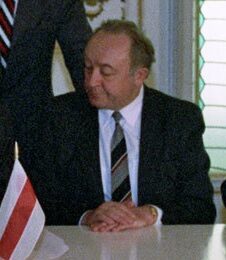
Picture: Wikimedia Commons: RIAN archive 848095 Signing the Agreement to eliminate the USSR and establish the Commonwealth of Independent States.jpg · See Commons file page