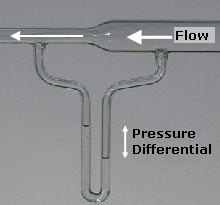
Bernoulli's principle
Bernoulli's principle is a principle relating to fluid dynamics. It is based on Bernoulli's equation.
All 3 facts, and where they come from
Facts
3 facts · 0 confirmed by two sources · 0 cited · 3 from one source
Where this comes from
Papalocal keeps its own record. It started from these sources; what each one said is kept here as it was copied, so a change on their side never changes this page by itself. Tap one to read its version.
What Wikidata says · copied November 17, 2026 · revision 2555134384
- Described as
- principle relating to fluid dynamics
- Other names
- Bernoulli's equation
- What it is
- physical law
- Based on
- Bernoulli's equation
- Named after
- Daniel Bernoulli
- Wikipedias with a page
- 72
Wikidata item Q181328 (wikidata.org/wiki/Q181328), public domain (CC0). Copied 2026-11-17.
What Wikipedia says · copied November 17, 2026 · revision 1383957221
Bernoulli's principle is a concept in fluid dynamics that relates pressure, speed and height. For example, for a fluid flowing horizontally, Bernoulli's principle states that an increase in the speed occurs simultaneously with a decrease in pressure. The principle is named after the Swiss mathematician and physicist Daniel Bernoulli, who published it in his book Hydrodynamica in 1738. Although Bernoulli deduced that pressure decreases when the flow speed increases, it was Leonhard Euler in 1752 who derived Bernoulli's equation in its usual form.
Bernoulli's principle can be derived directly from Isaac Newton's second law of motion. When a small volume of fluid is flowing horizontally from a region of high pressure to a region of low pressure, there is more pressure from behind than in front. This gives a net force on the volume, accelerating it along the streamline. If the pressure is decreasing along the streamline, the fluid is accelerated and the speed increases. Thus the decrease of pressure is the cause of a higher speed. Similarly, if the pressure is increasing, the speed decreases.
Bernoulli's principle can also be derived from the principle of conservation of energy. In a steady fluid flow the total of all forms of energy is conserved. This requires that the sum of kinetic energy, potential energy and internal energy remains constant. Thus an increase in the kinetic energy of the fluid occurs with a simultaneous decrease in its potential energy and internal energy.
From the Wikipedia article “Bernoulli's principle” (en.wikipedia.org/wiki/Bernoulli's_principle), by its contributors, under CC BY-SA 4.0 (creativecommons.org/licenses/by-sa/4.0/). Copied 2026-11-17; not changed.
Confirmed Two sources agree. Cited One source, and it names where it got it. One source One source, without a reference of its own. Sources disagree The sources disagree. We show the best-supported value and keep theirs below.
Picture: user:ComputerGeezer and Geof, via Wikimedia Commons · CC BY-SA 3.0