Bethe formula
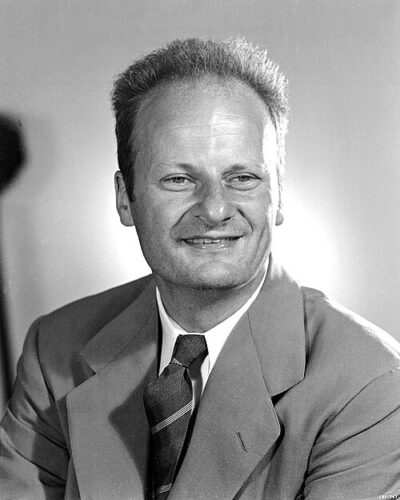
Bethe formula is a moving charge energy loss formula found by Hans Bethe.
All 4 facts, and where they come from
Facts
4 facts · 0 confirmed by two sources · 0 cited · 4 from one source
Where this comes from
Papalocal keeps its own record. It started from these sources; what each one said is kept here as it was copied, so a change on their side never changes this page by itself. Tap one to read its version.
What Wikidata says · copied November 16, 2026 · revision 2526116784
- Described as
- moving charge energy loss formula found by Hans Bethe
- Other names
- Bethe-Bloch formula
- What it is
- formula; scientific theory
- Named after
- Hans Bethe; Felix Bloch
- Wikipedias with a page
- 14
Wikidata item Q831230 (wikidata.org/wiki/Q831230), public domain (CC0). Copied 2026-11-16.
What Wikipedia says · copied November 16, 2026 · revision 1383701078
The Bethe formula or Bethe–Bloch formula describes the mean energy loss per distance travelled of swift charged particles (protons, alpha particles, atomic ions) traversing matter (or alternatively the stopping power of the material). For electrons the energy loss is slightly different due to their small mass (requiring relativistic corrections) and their indistinguishability, and since they suffer much larger losses by Bremsstrahlung, terms must be added to account for this. Fast charged particles moving through matter interact with the electrons of atoms in the material. The interaction excites or ionizes the atoms, leading to an energy loss of the traveling particle.
The non-relativistic version was found by Hans Bethe in 1930; the relativistic version (shown below) was found by him in 1932. The most probable energy loss differs from the mean energy loss and is described by the Landau–Vavilov distribution.
From the Wikipedia article “Bethe formula” (en.wikipedia.org/wiki/Bethe_formula), by its contributors, under CC BY-SA 4.0 (creativecommons.org/licenses/by-sa/4.0/). Copied 2026-11-16; not changed.
Confirmed Two sources agree. Cited One source, and it names where it got it. One source One source, without a reference of its own. Sources disagree The sources disagree. We show the best-supported value and keep theirs below.