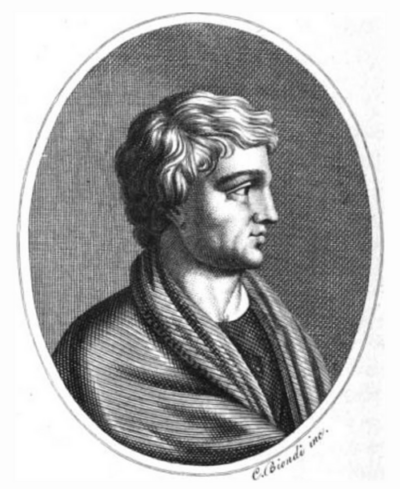
Bibliotheca historica
Bibliotheca historica is a world history written by Diodorus Siculus.
- Written by
- Diodorus Siculus
- Genre
- historiography
All 4 facts, and where they come from
Facts
4 facts · 0 confirmed by two sources · 0 cited · 4 from one source
Where this comes from
Papalocal keeps its own record. It started from these sources; what each one said is kept here as it was copied, so a change on their side never changes this page by itself. Tap one to read its version.
What Wikidata says · copied November 17, 2026 · revision 2488620184
- Described as
- world history written by Diodorus Siculus
- Other names
- Historical Library, Diod.
- What it is
- written work
- Written by
- Diodorus Siculus
- Genre
- historiography
- Language
- Ancient Greek
- Wikipedias with a page
- 22
Wikidata item Q672803 (wikidata.org/wiki/Q672803), public domain (CC0). Copied 2026-11-17.
What Wikipedia says · copied November 17, 2026 · revision 1367038500
Bibliotheca Historica (Latin; Greek: Βιβλιοθήκη Ἱστορική, Bibliothḗkē Historikḗ), also known as the Historical Library or Library of History, is a work of universal history by Diodorus Siculus. It consisted of forty books, which were divided into three sections.
The first six books are geographical in theme and describe the history and culture of Egypt (Book I), of Mesopotamia, India, Scythia, and Arabia (II), of North Africa (III), and of Greece and Europe (IV–VI). In the next ten books, he recounts human history starting with the Trojan War (Book VII) down to the death of Alexander the Great (XVII). The final section concerns the historical events from the successors of Alexander (Book XVIII) down to the time of the First Triumvirate of the late Roman Republic (XL). The end of the work has been lost, and it is unclear whether Diodorus actually reached the beginning of Caesar's Gallic War in 59 BC (as he promises at the beginning of the work) or, as evidence suggests, he stopped short at 60 BC owing to old age and weariness from his labors.
He selected the name "Library" as an acknowledgement that he was assembling a composite work drawing from many sources. Of the authors he used, some who have been identified include Hecataeus of Abdera, Ctesias of Cnidus, Ephorus, Theopompus, Hieronymus of Cardia, Duris of Samos, Diyllus, Philistus, Timaeus, Polybius, and Posidonius.
Diodorus's immense work has not survived intact. Only Books I–V and Books XI–XX remain in their entirety. The rest exists only in fragments preserved in Photius and in the Excerpta of Constantine Porphyrogenitus.
From the Wikipedia article “Bibliotheca Historica” (en.wikipedia.org/wiki/Bibliotheca_Historica), by its contributors, under CC BY-SA 4.0 (creativecommons.org/licenses/by-sa/4.0/). Copied 2026-11-17; not changed.
Confirmed Two sources agree. Cited One source, and it names where it got it. One source One source, without a reference of its own. Sources disagree The sources disagree. We show the best-supported value and keep theirs below.
Picture: Wikimedia Commons: Diodoro siculo, historiae, manoscritto S.XXIL.1, 1450 ca. 01.JPG · See Commons file page