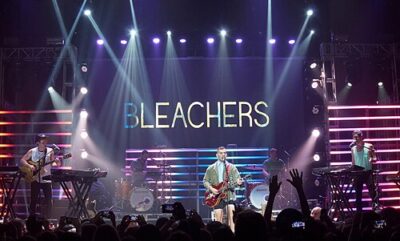
Bleachers
Bleachers is an American alternative rock band.
- Genre
- indie pop
- Record label
- RCA Records
- Country of origin
- United States
All 5 facts, and where they come from
Facts
5 facts · 0 confirmed by two sources · 0 cited · 5 from one source
Where this comes from
Papalocal keeps its own record. It started from these sources; what each one said is kept here as it was copied, so a change on their side never changes this page by itself. Tap one to read its version.
What Wikidata says · copied November 17, 2026 · revision 2568665658
- Described as
- American alternative rock band
- What it is
- musical group
- Genre
- indie pop · 1 reference
- Country of origin
- United States
- Record label
- RCA Records
- Official website
- http://www.bleachersmusic.com/
- Wikipedias with a page
- 12
Wikidata item Q16247210 (wikidata.org/wiki/Q16247210), public domain (CC0). Copied 2026-11-17.
What Wikipedia says · copied November 17, 2026 · revision 1385518679
Bleachers is an American rock band from New Jersey, formed in 2013 by musician Jack Antonoff. Antonoff was the only permanent member of the group until 2023, when longtime touring musicians Mikey Freedom Hart, Sean Hutchinson, Evan Smith, Michael Riddleberger, and Zem Audu became official members.
Bleachers' early music was heavily influenced by the late 1980s and early 1990s, plus the high school-based films of John Hughes while still using modern production techniques.
Their debut single "I Wanna Get Better" was released in February 2014, followed by five studio albums: Strange Desire (2014), Gone Now (2017), Take the Sadness Out of Saturday Night (2021), Bleachers (2024), and Everyone for Ten Minutes (2026). The band has also released a re-recording of their debut album, titled, A Stranger Desired (2024)
From the Wikipedia article “Bleachers (band)” (en.wikipedia.org/wiki/Bleachers_(band)), by its contributors, under CC BY-SA 4.0 (creativecommons.org/licenses/by-sa/4.0/). Copied 2026-11-17; not changed.
Confirmed Two sources agree. Cited One source, and it names where it got it. One source One source, without a reference of its own. Sources disagree The sources disagree. We show the best-supported value and keep theirs below.
Picture: Justin Higuchi, via Wikimedia Commons · CC BY 2.0