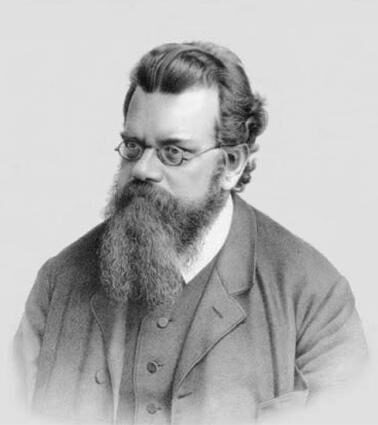
Boltzmann distribution
Boltzmann distribution is a probability distribution of energy states of a system.
All 2 facts, and where they come from
Facts
2 facts · 0 confirmed by two sources · 0 cited · 2 from one source
Where this comes from
Papalocal keeps its own record. It started from these sources; what each one said is kept here as it was copied, so a change on their side never changes this page by itself. Tap one to read its version.
What Wikidata says · copied November 17, 2026 · revision 2541696765
- Described as
- probability distribution of energy states of a system
- What it is
- probability distribution
- Named after
- Ludwig Boltzmann
- Wikipedias with a page
- 31
Wikidata item Q834200 (wikidata.org/wiki/Q834200), public domain (CC0). Copied 2026-11-17.
What Wikipedia says · copied November 17, 2026 · revision 1368789212
In statistical mechanics and mathematics, a Boltzmann distribution (also called Gibbs distribution) is a probability distribution or probability measure that gives the probability that a system will be in a certain state as a function of that state's energy and the temperature of the system. The distribution is expressed in the form
pi∝exp(−εikBT),
where pi is the probability of the system being in state i, exp is the exponential function, εi is the energy of that state, and a constant kBT of the distribution is the product of the Boltzmann constant kB and thermodynamic temperature T. The symbol ∝ denotes proportionality (see § The distribution for the proportionality constant).
The term system here has a wide meaning; it can range from a collection of "sufficient number" of atoms or a single atom to a macroscopic system such as a natural-gas storage tank. Therefore, the Boltzmann distribution can be used to solve a wide variety of problems. The distribution shows that states with lower energy will always have a higher probability of being occupied.
The ratio of probabilities of two states is known as the Boltzmann factor and only depends on the states' energy difference:
pipj=exp(−εikBT−−εjkBT)=exp(εj−εikBT).
The Boltzmann distribution is named after Ludwig Boltzmann, who first formulated it in 1868 during his studies of the statistical mechanics of gases in thermal equilibrium. Boltzmann's statistical work is borne out in his paper "On the Relationship between the Second Fundamental Theorem of the Mechanical Theory of Heat and Probability Calculations Regarding the Conditions for Thermal Equilibrium"
The distribution was later investigated extensively, in its modern generic form, by Josiah Willard Gibbs in 1902.
The Boltzmann distribution should not be confused with the Maxwell–Boltzmann distribution or Maxwell–Boltzmann statistics. The Boltzmann distribution gives the probability that a system will be in a certain state as a function of that state's energy, while the Maxwell–Boltzmann distributions give the probabilities of particle speeds or energies in ideal gases. The distribution of energies in a one-dimensional gas, however, does follow the Boltzmann distribution.
From the Wikipedia article “Boltzmann distribution” (en.wikipedia.org/wiki/Boltzmann_distribution), by its contributors, under CC BY-SA 4.0 (creativecommons.org/licenses/by-sa/4.0/). Copied 2026-11-17; not changed.
Confirmed Two sources agree. Cited One source, and it names where it got it. One source One source, without a reference of its own. Sources disagree The sources disagree. We show the best-supported value and keep theirs below.