Book of Optics
Book of Optics is a 11th century treatise on optics by Ibn al-Haytham. It came out in 1021.
- Published
- 1021
- Written by
- Ibn al-Haytham
All 4 facts, and where they come from
Facts
4 facts · 0 confirmed by two sources · 0 cited · 4 from one source
Where this comes from
Papalocal keeps its own record. It started from these sources; what each one said is kept here as it was copied, so a change on their side never changes this page by itself. Tap one to read its version.
What Wikidata says · copied November 17, 2026 · revision 2517561300
- Described as
- 11th century treatise on optics by Ibn al-Haytham
- What it is
- written work
- Written by
- Ibn al-Haytham
- Published
- 1021
- Language
- Arabic · 1 reference
- Wikipedias with a page
- 19
Wikidata item Q264562 (wikidata.org/wiki/Q264562), public domain (CC0). Copied 2026-11-17.
What Wikipedia says · copied November 17, 2026 · revision 1385509804
The Book of Optics (Arabic: كتاب المناظر, romanized: Kitāb al-Manāẓir; Latin: De Aspectibus or Perspectiva; Italian: Deli Aspecti) is a seven-volume treatise on optics and other fields of study composed by the medieval Arab scholar Ibn al-Haytham, known in the West as Alhazen or Alhacen (965 – c. 1040 AD).
The Book of Optics presented experimentally founded arguments against the widely held extramission theory of vision (as held by Euclid in his Optica), and proposed the modern intromission theory, the now accepted model that vision takes place by light entering the eye. The book is also noted for its early use of the scientific method, its description of the camera obscura, and its formulation of Alhazen's problem. The book extensively affected the development of optics, physics and mathematics in Europe between the 13th and 17th centuries.
From the Wikipedia article “Book of Optics” (en.wikipedia.org/wiki/Book_of_Optics), by its contributors, under CC BY-SA 4.0 (creativecommons.org/licenses/by-sa/4.0/). Copied 2026-11-17; not changed.
Confirmed Two sources agree. Cited One source, and it names where it got it. One source One source, without a reference of its own. Sources disagree The sources disagree. We show the best-supported value and keep theirs below.
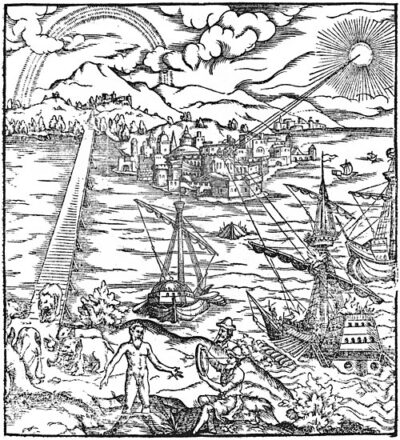
Picture: Unknown illustrator, via Wikimedia Commons · Public domain