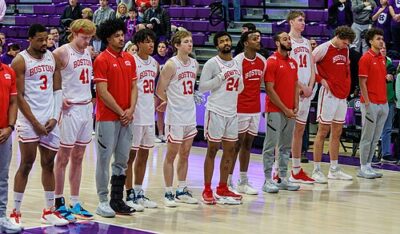
Boston University Terriers men's basketball
Boston University Terriers men's basketball is men's college basketball team. It plays in the NCAA Division I men's basketball. Its home is Case Gym. Its head coach is Joe Jones.
- Sport
- basketball
- League
- NCAA Division I men's basketball (1916–)
- Home venue
- Case Gym
- Head coach
- Joe Jones (2011–)
All 8 facts, and where they come from
Facts
8 facts · 0 confirmed by two sources · 4 cited · 4 from one source
Where this comes from
Papalocal keeps its own record. It started from these sources; what each one said is kept here as it was copied, so a change on their side never changes this page by itself. Tap one to read its version.
What Wikidata says · copied November 17, 2026 · revision 2353918337
- Described as
- men's college basketball team
- Other names
- Boston University Terriers, Boston University Terriers basketball
- What it is
- basketball team · 1 reference; college sports team
- Country
- United States
- Sport
- basketball · 1 reference
- League
- NCAA Division I men's basketball (1916–) · 1 reference
- Home venue
- Case Gym
- Head coach
- Joe Jones (2011–) · 1 reference
- Official website
- http://www.goterriers.com/index.aspx?path=mbball
- Wikipedias with a page
- 1
Wikidata item Q4948192 (wikidata.org/wiki/Q4948192), public domain (CC0). Copied 2026-11-17.
What Wikipedia says · copied November 17, 2026 · revision 1383927594
The Boston University Terriers men's basketball team is the intercollegiate basketball team that represents Boston University in Boston, Massachusetts, United States. The school's team currently competes in the Patriot League. The Terriers have appeared seven times in the NCAA tournament, making their most recent appearance in 2011.
From the Wikipedia article “Boston University Terriers men's basketball” (en.wikipedia.org/wiki/Boston_University_Terriers_men's_basketball), by its contributors, under CC BY-SA 4.0 (creativecommons.org/licenses/by-sa/4.0/). Copied 2026-11-17; not changed.
Confirmed Two sources agree. Cited One source, and it names where it got it. One source One source, without a reference of its own. Sources disagree The sources disagree. We show the best-supported value and keep theirs below.
Picture: Kenneth C. Zirkel, via Wikimedia Commons · CC BY-SA 4.0