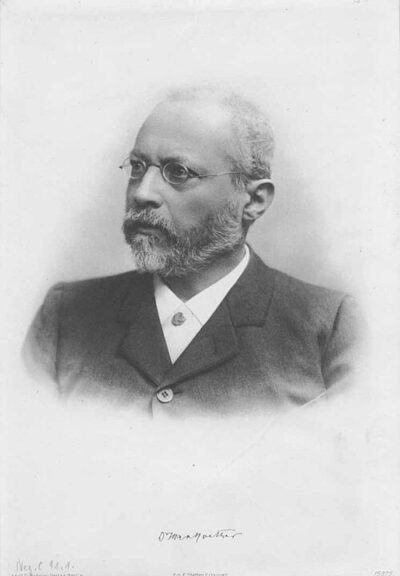
Brill–Noether theory
Brill–Noether theory is a study of special divisors, certain divisors on a curve that determine more compatible functions than would be predicted.
All 3 facts, and where they come from
Facts
3 facts · 0 confirmed by two sources · 0 cited · 3 from one source
Where this comes from
Papalocal keeps its own record. It started from these sources; what each one said is kept here as it was copied, so a change on their side never changes this page by itself. Tap one to read its version.
What Wikidata says · copied November 18, 2026 · revision 2550159330
- Described as
- study of special divisors, certain divisors on a curve that determine more compatible functions than would be predicted
- What it is
- mathematical theory
- Named after
- Alexander von Brill; Max Noether
- Wikipedias with a page
- 4
Wikidata item Q3032324 (wikidata.org/wiki/Q3032324), public domain (CC0). Copied 2026-11-18.
What Wikipedia says · copied November 18, 2026 · revision 1344325023
In algebraic geometry, Brill–Noether theory, introduced by Alexander von Brill and Max Noether (1874), is the study of special divisors, certain divisors on a curve C that determine more compatible functions than would be predicted. In classical language, special divisors move on the curve in a "larger than expected" linear system of divisors.
Throughout, we consider a projective smooth curve over the complex numbers (or over some other algebraically closed field).
The condition to be a special divisor D can be formulated in sheaf cohomology terms, as the non-vanishing of the H1 cohomology of the sheaf of sections of the invertible sheaf or line bundle associated to D. This means that, by the Riemann–Roch theorem, the H0 cohomology or space of holomorphic sections is larger than expected.
Alternatively, by Serre duality, the condition is that there exist holomorphic differentials with divisor ≥ –D on the curve.
From the Wikipedia article “Brill–Noether theory” (en.wikipedia.org/wiki/Brill–Noether_theory), by its contributors, under CC BY-SA 4.0 (creativecommons.org/licenses/by-sa/4.0/). Copied 2026-11-18; not changed.
Confirmed Two sources agree. Cited One source, and it names where it got it. One source One source, without a reference of its own. Sources disagree The sources disagree. We show the best-supported value and keep theirs below.