Bringing Up Baby
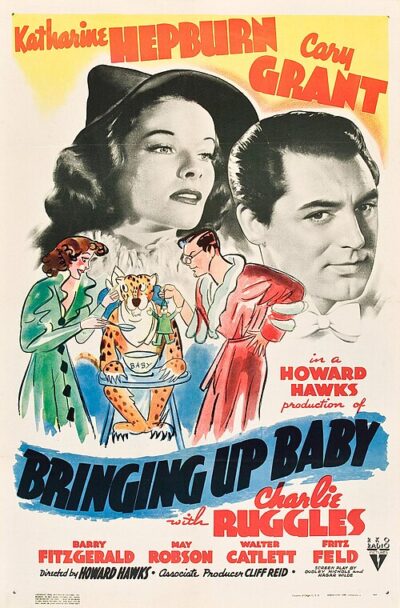
Bringing Up Baby is a 1938 film by Howard Hawks. It stars Katharine Hepburn, Cary Grant and Charles Ruggles.
- Released
- 1938
- Directed by
- Howard Hawks
- Genre
- romantic comedy film
- Country of origin
- United States
All 22 facts, and where they come from
Facts
22 facts · 0 confirmed by two sources · 11 cited · 11 from one source
Where this comes from
Papalocal keeps its own record. It started from these sources; what each one said is kept here as it was copied, so a change on their side never changes this page by itself. Tap one to read its version.
What Wikidata says · copied November 16, 2026 · revision 2567970560
- Described as
- 1938 film by Howard Hawks
- What it is
- film
- Directed by
- Howard Hawks · 3 references
- Music by
- Roy Webb
- Screenplay by
- Dudley Nichols; Hagar Wilde
- Produced by
- Howard Hawks; Cliff Reid
- Starring
- Katharine Hepburn · 3 references; Cary Grant · 2 references; Charles Ruggles · 2 references; Walter Catlett · 1 reference; May Robson · 2 references; Fritz Feld · 1 reference; Barry Fitzgerald · 1 reference; Tala Birell · 1 reference; Billy Bevan · 1 reference; Ward Bond · 1 reference
- Genre
- romantic comedy film; screwball comedy film
- Released
- February 18, 1938 · 1 reference; March 18, 1966 · 1 reference; 1938 · 1 reference
- Original language
- English
- Country of origin
- United States
- Wikipedias with a page
- 46
Wikidata item Q179743 (wikidata.org/wiki/Q179743), public domain (CC0). Copied 2026-11-16.
What Wikipedia says · copied November 16, 2026 · revision 1378976266
Bringing Up Baby is a 1938 American screwball comedy film directed by Howard Hawks, and starring Katharine Hepburn and Cary Grant. It was released by RKO Radio Pictures. The film tells the story of a paleontologist in a number of predicaments involving a scatterbrained heiress and a leopard named Baby. The screenplay was adapted by Dudley Nichols and Hagar Wilde from a short story by Wilde which originally appeared in Collier's Weekly magazine in April 1937.
The script was written specifically for Hepburn, and tailored to her personality. Filming began in September 1937 and wrapped in January 1938, behind schedule and over budget. Production was frequently delayed by Hepburn and Grant's uncontrollable laughing fits. Hepburn struggled with her comedic performance and was coached by another cast member, vaudeville veteran Walter Catlett. A tame leopard named Nissa was used during the shooting and played two roles in the film; Nissa's trainer stood off-screen with a whip for all of its scenes.
Bringing Up Baby had the reputation of a flop upon its release, although it eventually made a small profit after its re-release in the early 1940s. Labeled "box office poison" by the Independent Theatre Owners of America, Hepburn saw her career wane until The Philadelphia Story two years later. Bringing Up Baby's reputation began to grow during the 1950s when it was shown on television gaining acclaim for its perfectly timed over-the-top screwball comedy. In 1990 it was selected for preservation in the National Film Registry of the Library of Congress as "culturally, historically, or aesthetically significant", and has appeared on a number of greatest-films rankings, including the American Film Institute's 100 Years...100 Movies list. Some have considered it one of the greatest comedy films of all time.
From the Wikipedia article “Bringing Up Baby” (en.wikipedia.org/wiki/Bringing_Up_Baby), by its contributors, under CC BY-SA 4.0 (creativecommons.org/licenses/by-sa/4.0/). Copied 2026-11-16; not changed.
Confirmed Two sources agree. Cited One source, and it names where it got it. One source One source, without a reference of its own. Sources disagree The sources disagree. We show the best-supported value and keep theirs below.
Picture: Illustrator unknown; "Copyright 1938 RKO Radio Pictures, Inc.", via Wikimedia Commons · Public domain