Buffon's needle
Buffon's needle is a question in geometric probability.
All 3 facts, and where they come from
Facts
3 facts · 0 confirmed by two sources · 0 cited · 3 from one source
Where this comes from
Papalocal keeps its own record. It started from these sources; what each one said is kept here as it was copied, so a change on their side never changes this page by itself. Tap one to read its version.
What Wikidata says · copied November 17, 2026 · revision 2488204374
- Described as
- question in geometric probability
- Other names
- Buffon's needle problem
- What it is
- experiment; mathematical problem; mathematical concept
- Wikipedias with a page
- 23
Wikidata item Q1753097 (wikidata.org/wiki/Q1753097), public domain (CC0). Copied 2026-11-17.
What Wikipedia says · copied November 17, 2026 · revision 1381594355
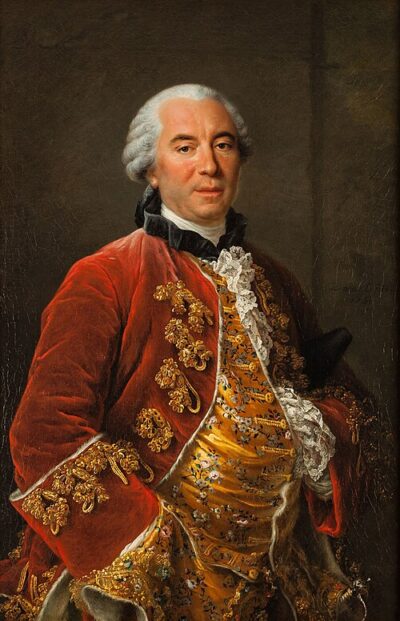
In probability theory, Buffon's needle problem is a question first posed in the 18th century by Georges-Louis Leclerc, Comte de Buffon:
Suppose we have a floor made of parallel strips of wood, each the same width, and we drop a needle onto the floor. What is the probability that the needle will lie across a line between two strips?
Buffon's needle was one of the earliest problems in geometric probability to be solved; it can be solved using integral geometry. The solution for the sought probability p, in the case where the needle length l is not greater than the width t of the strips, isp=2π⋅lt.
This can be used to design a Monte Carlo method for approximating the number π, although that was not the original motivation for de Buffon's question. The seemingly unusual appearance of π in this expression occurs because the underlying probability distribution function for the needle orientation is rotationally symmetric.
Scientists found that Temnothorax albipennis (rock ants) use the Buffon needle algorithm to estimate the size of potential nests.
From the Wikipedia article “Buffon's needle problem” (en.wikipedia.org/wiki/Buffon's_needle_problem), by its contributors, under CC BY-SA 4.0 (creativecommons.org/licenses/by-sa/4.0/). Copied 2026-11-17; not changed.
Confirmed Two sources agree. Cited One source, and it names where it got it. One source One source, without a reference of its own. Sources disagree The sources disagree. We show the best-supported value and keep theirs below.