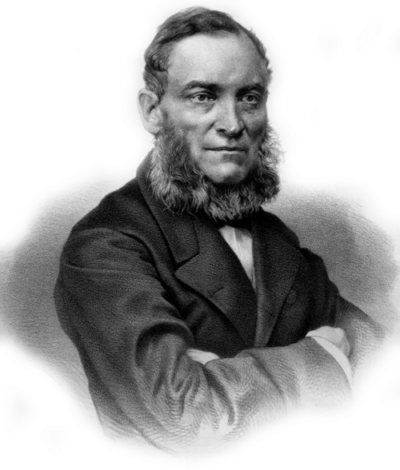
Bunyakovsky conjecture
Bunyakovsky conjecture is a conjecture that gives a criterion for a univariate integer-coefficient polynomial to give infinitely many prime values. It came out in 1857.
- Came out
- 1857
All 3 facts, and where they come from
Facts
3 facts · 0 confirmed by two sources · 0 cited · 3 from one source
Where this comes from
Papalocal keeps its own record. It started from these sources; what each one said is kept here as it was copied, so a change on their side never changes this page by itself. Tap one to read its version.
What Wikidata says · copied November 18, 2026 · revision 2567530918
- Described as
- conjecture that gives a criterion for a univariate integer-coefficient polynomial to give infinitely many prime values
- Other names
- Bouniakowsky conjecture
- What it is
- conjecture · 1 reference
- Came out
- 1857 · 1 reference
- Named after
- Viktor Bunyakovsky · 1 reference
- Wikipedias with a page
- 13
Wikidata item Q1139180 (wikidata.org/wiki/Q1139180), public domain (CC0). Copied 2026-11-18.
What Wikipedia says · copied November 18, 2026 · revision 1328429627
The Bunyakovsky conjecture (or Bouniakowsky conjecture) gives a criterion for a polynomial f(x) in one variable with integer coefficients to give infinitely many prime values in the sequencef(1),f(2),f(3),…. It was stated in 1857 by the Russian mathematician Viktor Bunyakovsky. The following three conditions are necessary for f(x) to have the desired prime-producing property:
The leading coefficient is positive,
The polynomial is irreducible over the rationals (and integers), and
The values f(1),f(2),f(3),… have no common factor larger than 1. (In particular, the coefficients of f(x) should be relatively prime.)
Bunyakovsky's conjecture is that these conditions are sufficient: if f(x) satisfies (1)–(3), then f(n) is prime for infinitely many positive integers n.
A seemingly weaker yet equivalent statement to Bunyakovsky's conjecture is that for every integer polynomial f(x) that satisfies (1)–(3), f(n) is prime for at least one positive integer n: but then, since the translated polynomial f(x+n) still satisfies (1)–(3), in view of the weaker statement f(m) is prime for at least one positive integer m>n, so that f(n) is indeed prime for infinitely many positive integers n. Bunyakovsky's conjecture is a special case of Schinzel's hypothesis H, one of the most famous open problems in number theory.
From the Wikipedia article “Bunyakovsky conjecture” (en.wikipedia.org/wiki/Bunyakovsky_conjecture), by its contributors, under CC BY-SA 4.0 (creativecommons.org/licenses/by-sa/4.0/). Copied 2026-11-18; not changed.
Confirmed Two sources agree. Cited One source, and it names where it got it. One source One source, without a reference of its own. Sources disagree The sources disagree. We show the best-supported value and keep theirs below.