Calvin and Hobbes
Calvin and Hobbes is a comic strip by Bill Watterson. It came out in 1985. It won the Best foreign work published in Spain.
- Came out
- November 18, 1985
- Written by
- Bill Watterson
- Created by
- Bill Watterson
- Country of origin
- United States
All 8 facts, and where they come from
Facts
8 facts · 0 confirmed by two sources · 0 cited · 8 from one source
Where this comes from
Papalocal keeps its own record. It started from these sources; what each one said is kept here as it was copied, so a change on their side never changes this page by itself. Tap one to read its version.
What Wikidata says · copied November 17, 2026 · revision 2548171357
- Described as
- comic strip by Bill Watterson
- What it is
- comic strip series; media franchise
- Written by
- Bill Watterson
- Created by
- Bill Watterson · 1 reference
- Publisher
- Andrews McMeel Publishing
- Country of origin
- United States
- Came out
- November 18, 1985
- Awards
- Best foreign work published in Spain (1991)
- Wikipedias with a page
- 47
Wikidata item Q211035 (wikidata.org/wiki/Q211035), public domain (CC0). Copied 2026-11-17.
What Wikipedia says · copied November 17, 2026 · revision 1385038039
Calvin and Hobbes is an American daily comic strip created by cartoonist Bill Watterson and syndicated from November 18, 1985, to December 31, 1995. The strip centers on Calvin, a six-year-old boy characterized by his vivid imagination and rowdy behavior, and Hobbes, his stuffed tiger, who is a sentient being to Calvin but a regular toy to everyone else. Set in the contemporary United States, the strip includes a recurring cast such as Calvin's parents, his classmate Susie Derkins, his teacher Miss Wormwood, and his babysitter Rosalyn.
A recurring element of the strip is Calvin's use of imagination, often depicted through alter egos such as Spaceman Spiff and Stupendous Man, as well as his reinterpretation of everyday objects, including cardboard boxes, as devices such as time machines. Watterson's artistic style, influenced by earlier comic strips including Peanuts, Pogo, and Krazy Kat, developed over time to incorporate more varied panel layouts and watercolor illustrations in Sunday strips.
At its peak, Calvin and Hobbes was published in more than 2,000 newspapers internationally. Watterson firmly opposed the licensing of the strip's characters for commercial merchandise and engaged in disputes with his syndicate regarding creative control. As such, no official merchandise or animated adaptations were produced during the strip's original run. Watterson ended the strip in 1995, stating that he had explored the format to his satisfaction.
Described by some commentators as "the last great newspaper comic", Calvin and Hobbes has enjoyed enduring popularity and influence. The 18 official book collections have sold millions of copies globally, and the strip continues to attract significant academic and philosophical interest. In 2014, Watterson's contributions to the medium were recognized with the Grand Prix at the Angoulême International Comics Festival, cementing the strip's legacy as one of the most celebrated works in comic history.
From the Wikipedia article “Calvin and Hobbes” (en.wikipedia.org/wiki/Calvin_and_Hobbes), by its contributors, under CC BY-SA 4.0 (creativecommons.org/licenses/by-sa/4.0/). Copied 2026-11-17; not changed.
Confirmed Two sources agree. Cited One source, and it names where it got it. One source One source, without a reference of its own. Sources disagree The sources disagree. We show the best-supported value and keep theirs below.
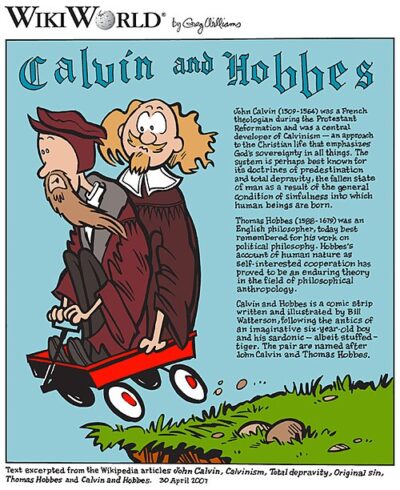
Picture: Greg Williams, via Wikimedia Commons · CC BY-SA 2.5