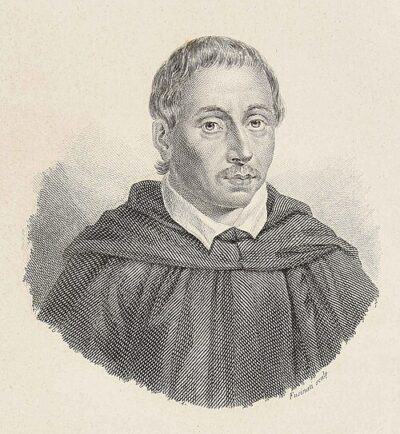
Cavalieri's principle
Cavalieri's principle is a modern implementation of the method of indivisibles.
All 4 facts, and where they come from
Facts
4 facts · 0 confirmed by two sources · 0 cited · 4 from one source
Where this comes from
Papalocal keeps its own record. It started from these sources; what each one said is kept here as it was copied, so a change on their side never changes this page by itself. Tap one to read its version.
What Wikidata says · copied November 17, 2026 · revision 2550160893
- Described as
- modern implementation of the method of indivisibles
- What it is
- method; mathematical theory
- Named after
- Bonaventura Cavalieri; Zu Gengzhi
- Wikipedias with a page
- 26
Wikidata item Q586686 (wikidata.org/wiki/Q586686), public domain (CC0). Copied 2026-11-17.
What Wikipedia says · copied November 17, 2026 · revision 1385370070
In geometry, Cavalieri's principle, a modern implementation of the method of indivisibles, named after Bonaventura Cavalieri, is as follows:
2-dimensional case: Suppose two regions in a plane are included between two parallel lines in that plane. If every line parallel to these two lines intersects both regions in line segments of equal length, then the two regions have equal areas.
3-dimensional case: Suppose two regions in three-space (solids) are included between two parallel planes. If every plane parallel to these two planes intersects both regions in cross-sections of equal area, then the two regions have equal volumes.
Today Cavalieri's principle is seen as an early step toward integral calculus and, while it is used in some forms, such as its generalization in Fubini's theorem and layer cake representation, results using Cavalieri's principle can often be shown more directly via integration. In the other direction, Cavalieri's principle grew out of the ancient Greek method of exhaustion, which used limits but did not use infinitesimals.
From the Wikipedia article “Cavalieri's principle” (en.wikipedia.org/wiki/Cavalieri's_principle), by its contributors, under CC BY-SA 4.0 (creativecommons.org/licenses/by-sa/4.0/). Copied 2026-11-17; not changed.
Confirmed Two sources agree. Cited One source, and it names where it got it. One source One source, without a reference of its own. Sources disagree The sources disagree. We show the best-supported value and keep theirs below.