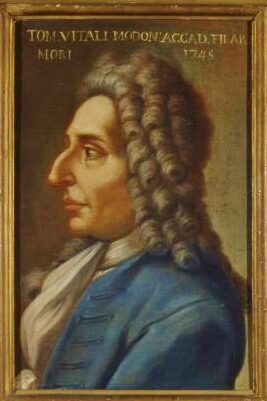
Chaconne in G minor (Vitali)
Chaconne in G minor (Vitali) is a Chaconne attributed to Tomaso Antonio Vitali.
All 2 facts, and where they come from
Facts
2 facts · 0 confirmed by two sources · 0 cited · 2 from one source
Where this comes from
Papalocal keeps its own record. It started from these sources; what each one said is kept here as it was copied, so a change on their side never changes this page by itself. Tap one to read its version.
What Wikidata says · copied November 18, 2026 · revision 2570066531
- Described as
- Chaconne attributed to Tomaso Antonio Vitali
- Other names
- Chaconne in G minor
- What it is
- musical work/composition
- Music by
- Tomaso Antonio Vitali
- Wikipedias with a page
- 6
Wikidata item Q2373190 (wikidata.org/wiki/Q2373190), public domain (CC0). Copied 2026-11-18.
What Wikipedia says · copied November 18, 2026 · revision 1370774514
The Chaconne in G minor is a Baroque composition for violin and continuo, attributed to the Italian composer Tomaso Antonio Vitali. A Dresden manuscript that may have been transcribed in the early 18th century is the earliest known version of the chaconne, but it was not published until 1867 when Ferdinand David arranged it for violin and piano. The origin of its composition has been debated, with some musicologists hypothesizing that the work is a musical hoax composed by David rather than Vitali. Léopold Charlier made significant alterations to the chaconne in the early 20th century, transforming it into a virtuosic, Romantic-style showpiece. It has been arranged by numerous other composers, including Hans Werner Henze, who used it as the basis for his work Il Vitalino raddoppiato (1977).
Differing somewhat from the major archetypes of ground bass variations, the chaconne features a descending tetrachord in the continuo part, the lowest voice (this bass-line pattern is traditionally associated with lament and figured, at a time, more prominently in the passacaglia), above which the violin part presents increasingly complex variations on the original theme. There are several abrupt changes in the key between variations, atypical of other chaconnes from the Baroque era. Some suggest that this characteristic, along with the observation that the chaconne is dissimilar to Vitali's other surviving compositions, is indicative of a different composer. Jascha Heifetz began his American debut recital at Carnegie Hall in 1917 with the chaconne and regularly performed it as part of his concert repertoire for the next four decades.
From the Wikipedia article “Chaconne in G minor” (en.wikipedia.org/wiki/Chaconne_in_G_minor), by its contributors, under CC BY-SA 4.0 (creativecommons.org/licenses/by-sa/4.0/). Copied 2026-11-18; not changed.
Confirmed Two sources agree. Cited One source, and it names where it got it. One source One source, without a reference of its own. Sources disagree The sources disagree. We show the best-supported value and keep theirs below.
Picture: Wikimedia Commons: Ferdinand david.jpg · See Commons file page