Chernoff bound
Chernoff bound is an exponentially decreasing bounds on tail distributions of sums of independent random variables.
All 4 facts, and where they come from
Facts
4 facts · 0 confirmed by two sources · 0 cited · 4 from one source
Where this comes from
Papalocal keeps its own record. It started from these sources; what each one said is kept here as it was copied, so a change on their side never changes this page by itself. Tap one to read its version.
What Wikidata says · copied November 19, 2026 · revision 2506186221
- Described as
- exponentially decreasing bounds on tail distributions of sums of independent random variables
- Other names
- Chernoff's inequality, Chernoff inequality, Chernoff bounds
- What it is
- upper bound; theorem; inequality
- Named after
- Herman Chernoff
- Wikipedias with a page
- 13
Wikidata item Q1070305 (wikidata.org/wiki/Q1070305), public domain (CC0). Copied 2026-11-19.
What Wikipedia says · copied November 19, 2026 · revision 1369037442
In probability theory, a Chernoff bound is an exponentially decreasing upper bound on the tail of a random variable based on its moment generating function. The minimum of all such exponential bounds forms the Chernoff or Chernoff-Cramér bound, which may decay faster than exponential (e.g. sub-Gaussian). It is especially useful for sums of independent random variables, such as sums of Bernoulli random variables.
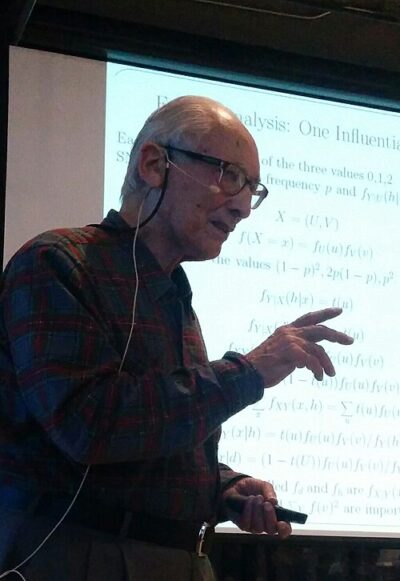
The bound is commonly named after Herman Chernoff who described the method in a 1952 paper, though Chernoff himself attributed it to Herman Rubin. In 1938 Harald Cramér had published an almost identical concept now known as Cramér's theorem.
It is a sharper bound than the first- or second-moment-based tail bounds such as Markov's inequality or Chebyshev's inequality, which only yield power-law bounds on tail decay. However, when applied to sums the Chernoff bound requires the random variables to be independent, a condition that is not required by either Markov's inequality or Chebyshev's inequality.
The Chernoff bound is related to the Bernstein inequalities. It is also used to prove Hoeffding's inequality, Bennett's inequality, and McDiarmid's inequality.
From the Wikipedia article “Chernoff bound” (en.wikipedia.org/wiki/Chernoff_bound), by its contributors, under CC BY-SA 4.0 (creativecommons.org/licenses/by-sa/4.0/). Copied 2026-11-19; not changed.
Confirmed Two sources agree. Cited One source, and it names where it got it. One source One source, without a reference of its own. Sources disagree The sources disagree. We show the best-supported value and keep theirs below.