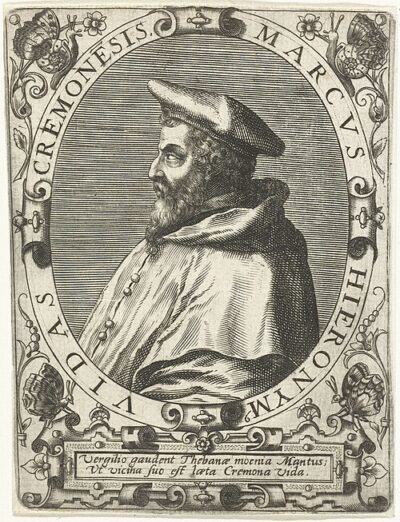
Christiad
Christiad is a book by Marco Girolamo Vida. It came out in 1535.
- Published
- 1535
- Written by
- Marco Girolamo Vida
- Genre
- Christusepik
- Country of origin
- Italy
All 7 facts, and where they come from
Facts
7 facts · 0 confirmed by two sources · 0 cited · 7 from one source
Where this comes from
Papalocal keeps its own record. It started from these sources; what each one said is kept here as it was copied, so a change on their side never changes this page by itself. Tap one to read its version.
What Wikidata says · copied November 19, 2026 · revision 2408045656
- Described as
- book by Marco Girolamo Vida
- What it is
- literary work
- Written by
- Marco Girolamo Vida
- Genre
- Christusepik; epic poem
- Published
- 1535
- Language
- Latin
- Country of origin
- Italy
- Wikipedias with a page
- 1
Wikidata item Q5109232 (wikidata.org/wiki/Q5109232), public domain (CC0). Copied 2026-11-19.
What Wikipedia says · copied November 19, 2026 · revision 1384745632
The Christiad (Latin Christias) is an epic poem in six cantos on the life of Jesus Christ by Marco Girolamo (Marcus Hieronymus) Vida modeled on Virgil. It was first published in Cremona in 1535 (see 1535 in poetry). According to Watson Kirkconnell, the Christiad, "was one of the most famous poems of the Early Renaissance". Furthermore, according to Kirkconnell, Vida's, "description of the Council in Hell, addressed by Lucifer, in Book I", was, "a feature later to be copied", by Torquato Tasso, Abraham Cowley, and by John Milton in Paradise Lost. The standard English translations, which render Vida's poem into heroic couplets, were published by John Cranwell in 1768 and by Edward Granan in 1771.
From the Wikipedia article “Christiad” (en.wikipedia.org/wiki/Christiad), by its contributors, under CC BY-SA 4.0 (creativecommons.org/licenses/by-sa/4.0/). Copied 2026-11-19; not changed.
Confirmed Two sources agree. Cited One source, and it names where it got it. One source One source, without a reference of its own. Sources disagree The sources disagree. We show the best-supported value and keep theirs below.