
Christian Social Party
The Christian Social Party is a former political party in Belgium (1945-1968). Its headquarters are in Brussels. It stands for Christian democracy, Christian humanism and Catholic social teaching.
- Country
- Belgium
- Founded
- August 18, 1945
- Ideology
- Christian democracy
All 9 facts, and where they come from
Facts
9 facts · 0 confirmed by two sources · 0 cited · 9 from one source
Where this comes from
Papalocal keeps its own record. It started from these sources; what each one said is kept here as it was copied, so a change on their side never changes this page by itself. Tap one to read its version.
What Wikidata says · copied November 17, 2026 · revision 2559203301
- Described as
- former political party in Belgium (1945-1968)
- Other names
- PSC-CVP, CVP, PSC, CVP-PSC
- What it is
- political party
- Comes after
- Catholic Party
- Founded
- August 18, 1945
- Ended
- 1968
- Headquarters
- Brussels · 1 reference
- Country
- Belgium
- Ideology
- Christian democracy; Christian humanism; Catholic social teaching
- Wikipedias with a page
- 13
Wikidata item Q3366715 (wikidata.org/wiki/Q3366715), public domain (CC0). Copied 2026-11-17.
What Wikipedia says · copied November 17, 2026 · revision 1379201938
The Christian Social Party (French: Parti Social Chrétien, pronounced [paʁti sɔsjal kʁetjɛ̃]; Dutch: Christelijke Volkspartij, pronounced [ˈkrɪstələkə ˈvɔlkspɑrˌtɛi], lit. 'Christian People's Party'; generally abbreviated to PSC–CVP) was a major political party in Belgium which existed from 1945 until 1968. It is sometimes referred to as the unitary Christian Social Party (PSC unitaire/unitaire CVP) to distinguish it from its two identically named successor parties.
Established as the successor to the pre-war Catholic Party, the PSC-CVP was established after Belgium's Liberation in World War II with an explicitly "deconfessionalised" orientation in the Christian Democratic tradition. It supported social welfare and limited economic redistribution. It remained the largest party in Belgian politics throughout much of its existence and was the last party in Belgian history to gain an outright majority in the 1950 elections. It provided a number of influential prime ministers and participated in most coalition governments in combination with the Belgian Socialist Party and the Liberal Party or its successor the Party for Freedom and Progress.
Amid rising regionalist tensions, the PSC-CVP's regional parties split along linguistic and regional lines between 1968 and 1972 to form the Francophone Christian Social Party (Parti Social Chrétien, PSC) and Flemish Christian People's Party (Christelijke Volkspartij, CVP).
From the Wikipedia article “Christian Social Party (Belgium, 1945–68)” (en.wikipedia.org/wiki/Christian_Social_Party_(Belgium,_1945–68)), by its contributors, under CC BY-SA 4.0 (creativecommons.org/licenses/by-sa/4.0/). Copied 2026-11-17; not changed.
Confirmed Two sources agree. Cited One source, and it names where it got it. One source One source, without a reference of its own. Sources disagree The sources disagree. We show the best-supported value and keep theirs below.
People connected 5
Party members
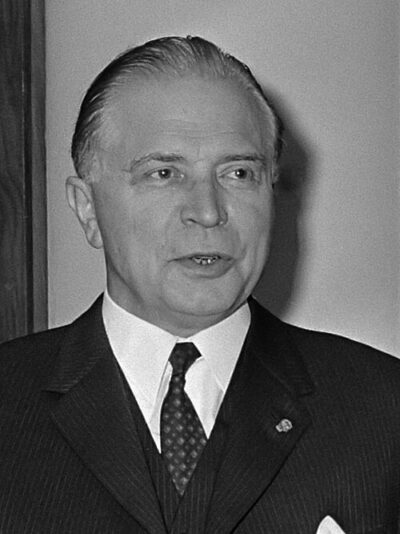 Gaston EyskensBelgian prime minister (1905-1988)
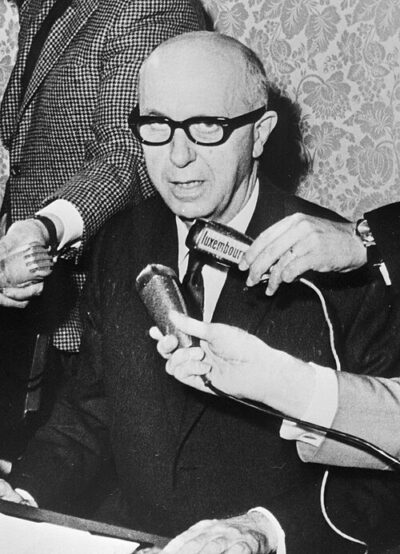 Pierre HarmelBelgian politician (1911-2009)
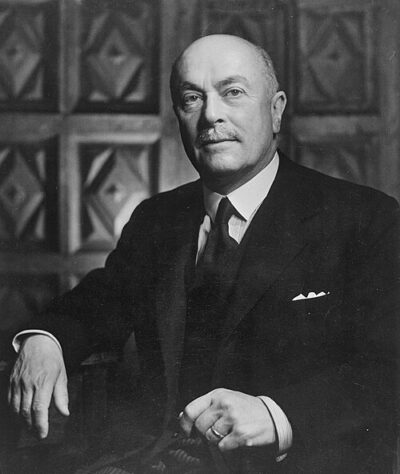 Hubert Pierlot (1945–)Belgian politician and 32nd Prime Minister of Belgium, serving between 1939 and 1945 (1883–1963)
 Paul Vanden Boeynants (–1972)Belgian politician (1919–2001)
 Jean Duvieusart (–1965)Belgian politician (1900-1977)
