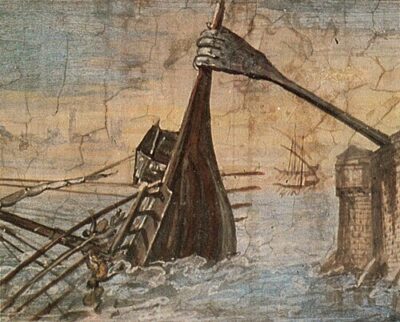
claw of Archimedes
Claw of Archimedes is a large fulcrum based pole with rope and anchor, by hooking ship and applying weight at other end, lift is applied to the vessel capsizing and scuttling it.
All 2 facts, and where they come from
Facts
2 facts · 0 confirmed by two sources · 0 cited · 2 from one source
Where this comes from
Papalocal keeps its own record. It started from these sources; what each one said is kept here as it was copied, so a change on their side never changes this page by itself. Tap one to read its version.
What Wikidata says · copied November 17, 2026 · revision 2511500520
- Described as
- large fulcrum based pole with rope and anchor, by hooking ship and applying weight at other end, lift is applied to the vessel capsizing and scuttling it.
- Other names
- Archimedes Claw, iron hand
- What it is
- weapon type
- Named after
- Archimedes
- Wikipedias with a page
- 23
Wikidata item Q146938 (wikidata.org/wiki/Q146938), public domain (CC0). Copied 2026-11-17.
What Wikipedia says · copied November 17, 2026 · revision 1299107380
The Claw of Archimedes (Ancient Greek: Ἁρπάγη, romanized: harpágē, lit. 'snatcher'; also known as the iron hand) was an ancient weapon devised by Archimedes to defend the seaward portion of Syracuse's city wall against amphibious assault. Although its exact nature is unclear, the accounts of ancient historians seem to describe it as a sort of crane equipped with a grappling hook that was able to lift an attacking quinquereme by the bow. By then releasing the claw the ship would fall onto the rocks or water below, inevitably capsizing. The claw could allegedly shake boats with such force that the crew would be thrown into the sea.
These machines featured prominently during the Second Punic War in 214 BC, when the Roman Republic attacked Syracuse with a fleet of 60 quinqueremes under Marcus Claudius Marcellus. When the Roman fleet approached the city walls under cover of darkness, the machines were deployed, sinking many ships and throwing the attack into confusion. Historians such as Livy attributed heavy Roman losses to these machines, together with catapults also devised by Archimedes.
The plausibility of this invention was tested in 1999 in the BBC series Secrets of the Ancients and again in early 2005 in the Discovery Channel series Superweapons of the Ancient World. The producers of Superweapons brought together a group of engineers tasked with conceiving and implementing a design that was realistic, given what is known about Archimedes. Within seven days they were able to test their creation, and they did succeed in tipping over a model of a Roman ship so that it would sink. While this does not prove the existence of the Claw, it suggests that it would have been possible.
From the Wikipedia article “Claw of Archimedes” (en.wikipedia.org/wiki/Claw_of_Archimedes), by its contributors, under CC BY-SA 4.0 (creativecommons.org/licenses/by-sa/4.0/). Copied 2026-11-17; not changed.
Confirmed Two sources agree. Cited One source, and it names where it got it. One source One source, without a reference of its own. Sources disagree The sources disagree. We show the best-supported value and keep theirs below.
Picture: Giulio Parigi, via Wikimedia Commons · Public domain