Code of Hammurabi
Code of Hammurabi is a Babylonian code of law or conduct. It came out in -1752.
- Released
- 1752 BC
All 5 facts, and where they come from
Facts
5 facts · 0 confirmed by two sources · 0 cited · 5 from one source
Where this comes from
Papalocal keeps its own record. It started from these sources; what each one said is kept here as it was copied, so a change on their side never changes this page by itself. Tap one to read its version.
What Wikidata says · copied November 17, 2026 · revision 2548716015
- Described as
- Babylonian code of law or conduct
- Other names
- Código de Hammuraby, Código de Hammurab, El Código de Hammurabi, Código de Hammurabi
- What it is
- code of law
- Released
- 1752 BC
- Language
- Akkadian
- Country
- Babylonia
- Named after
- Hammurabi
- Wikipedias with a page
- 100
Wikidata item Q93304 (wikidata.org/wiki/Q93304), public domain (CC0). Copied 2026-11-17.
What Wikipedia says · copied November 17, 2026 · revision 1384254682
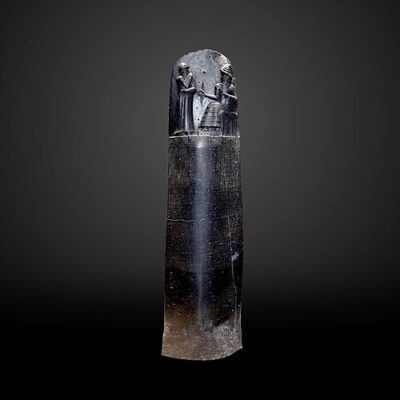
The Code of Hammurabi is a Babylonian legal text composed c. 1753 BC. It is one of the most recognizable legal texts from the ancient Near East, written in the Old Babylonian dialect of Akkadian, purportedly by Hammurabi, sixth king of the First Dynasty of Babylon. The primary copy of the text is inscribed on a basalt stele 2.25 m (7 ft 4+1⁄2 in) tall.
The stele was rediscovered in 1901 at the site of Susa in present-day Iran, where it had been taken as plunder 600 years after its creation. The text itself was copied and studied by Mesopotamian scribes for over a millennium. The stele now resides in the Louvre Museum.
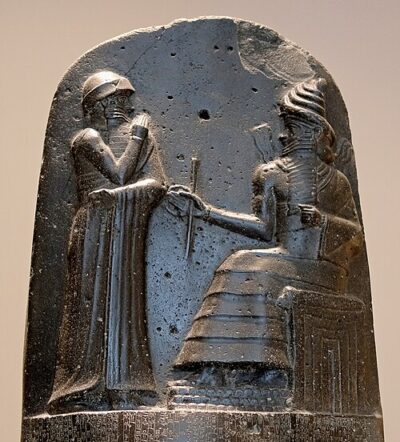
The top of the stele features an image in relief of Hammurabi with Shamash, the Babylonian sun god and god of justice. Below the relief are about 4,130 lines of cuneiform text: one fifth contains a prologue and epilogue in poetic style, while the remaining four fifths contain what are generally called the "laws". In the prologue, Hammurabi claims to have been granted his rule by the gods "to prevent the strong from oppressing the weak". The laws are casuistic, expressed as "if ... then" conditional sentences. Their scope is broad, including, for example, criminal law, family law, property law, and commercial law.
Modern scholars responded to the Code with admiration at its perceived fairness and respect for the rule of law, and at the complexity of Old Babylonian society. There was also much discussion of its influence on the Mosaic Law. Scholars quickly identified lex talionis—the "eye for an eye" principle—underlying the two collections. Debate among Assyriologists has since centred around several aspects of the Code: its purpose, its underlying principles, its language, and its relation to earlier and later law collections.
Despite the uncertainty surrounding these issues, Hammurabi is regarded outside Assyriology as an important figure in the history of law and the document as a true legal code. The U.S. Capitol has a relief portrait of Hammurabi alongside those of other historic lawgivers. There are replicas of the stele in numerous institutions, including the headquarters of the United Nations in New York City, the Pergamon Museum in Berlin and the University of Chicago's Institute for the Study of Ancient Cultures.
From the Wikipedia article “Code of Hammurabi” (en.wikipedia.org/wiki/Code_of_Hammurabi), by its contributors, under CC BY-SA 4.0 (creativecommons.org/licenses/by-sa/4.0/). Copied 2026-11-17; not changed.
Confirmed Two sources agree. Cited One source, and it names where it got it. One source One source, without a reference of its own. Sources disagree The sources disagree. We show the best-supported value and keep theirs below.
Picture: Mbzt, via Wikimedia Commons · CC BY 3.0