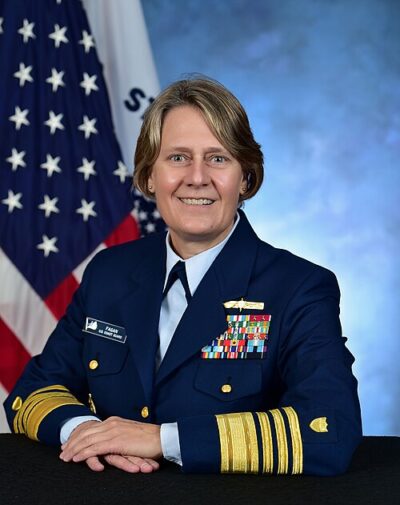
Commandant of the Coast Guard
The Commandant of the Coast Guard is a highest-ranking member of the United States Coast Guard. It was created in 1889.
- Office of
- United States
- Country
- United States
- Created
- December 14, 1889
All 5 facts, and where they come from
Facts
5 facts · 0 confirmed by two sources · 0 cited · 5 from one source
Where this comes from
Papalocal keeps its own record. It started from these sources; what each one said is kept here as it was copied, so a change on their side never changes this page by itself. Tap one to read its version.
What Wikidata says · copied November 20, 2026 · revision 2569464925
- Described as
- highest-ranking member of the United States Coast Guard
- What it is
- position
- Created
- December 14, 1889 · 1 reference
- Country
- United States
- Office of
- United States · 1 reference
- Official website
- https://www.uscg.mil/seniorleadership/
- Wikipedias with a page
- 11
Wikidata item Q688856 (wikidata.org/wiki/Q688856), public domain (CC0). Copied 2026-11-20.
What Wikipedia says · copied November 20, 2026 · revision 1378672779
The commandant of the Coast Guard is the service chief and highest-ranking member of the United States Coast Guard. The commandant is an admiral, appointed for a four-year term by the president of the United States upon confirmation by the United States Senate. The commandant is assisted by a vice commandant, who is also an admiral, and two area commanders (U.S. Coast Guard Pacific Area and U.S. Coast Guard Atlantic Area) and two deputy commandants (deputy commandant for operations and deputy commandant for mission support), all of whom are vice admirals.
Though the United States Coast Guard is one of the six military branches of the United States, unlike the other service chiefs, the commandant of the Coast Guard is not a member of the Joint Chiefs of Staff. The commandant is, however, entitled to the same supplemental pay as each member of the Joint Chiefs, per 37 U.S.C. § 414(a)(5) ($4,000 per annum in 2009), and is accorded privilege of the floor under Senate Rule XXIII(1) as a de facto Joint Chiefs of Staff member during presidential addresses.
The commandant maintains operational command over the Coast Guard, unlike the chiefs of the other services, who serve only administrative roles. Thus, while the operational chain of command for the other services (per the Goldwater–Nichols Act) goes from the president through the secretary of defense to the combatant commanders of the unified combatant commands, command and control of the Coast Guard goes from the president through the secretary of homeland security (or secretary of defense, when the Coast Guard is acting as a service in the Department of the Navy) through the commandant. Prior to the creation of the Department of Homeland Security in 2003, the United States Coast Guard or its predecessor, the Revenue Cutter Service operated under and the commandant reported to the secretary of transportation from 1966 to 2003, and the secretary of the treasury from 1790 until 1966.
As of 15 January 2026, the 28th commandant of the Coast Guard is Admiral Kevin Lunday.
From the Wikipedia article “Commandant of the Coast Guard” (en.wikipedia.org/wiki/Commandant_of_the_Coast_Guard), by its contributors, under CC BY-SA 4.0 (creativecommons.org/licenses/by-sa/4.0/). Copied 2026-11-20; not changed.
Confirmed Two sources agree. Cited One source, and it names where it got it. One source One source, without a reference of its own. Sources disagree The sources disagree. We show the best-supported value and keep theirs below.