Communist Party of Ukraine
Communist Party of Ukraine is a banned Marxist–Leninist political party in Ukraine. It was founded in 1993. Its headquarters are in Kyiv. It stands for Marxism–Leninism.
- Country
- Ukraine
- Founded
- June 19, 1993
- Ideology
- Marxism–Leninism
- Chair
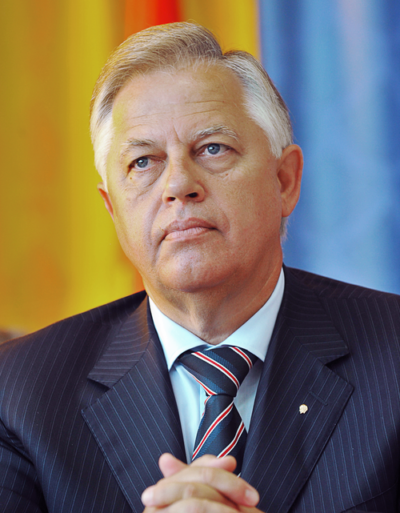
- Petro Symonenko
All 7 facts, and where they come from
Facts
7 facts · 0 confirmed by two sources · 1 cited · 6 from one source
Where this comes from
Papalocal keeps its own record. It started from these sources; what each one said is kept here as it was copied, so a change on their side never changes this page by itself. Tap one to read its version.
What Wikidata says · copied November 17, 2026 · revision 2555590994
- Described as
- banned Marxist–Leninist political party in Ukraine
- What it is
- communist party
- Comes after
- Communist Party of Ukraine
- Founded
- June 19, 1993
- Headquarters
- Kyiv
- Country
- Ukraine
- Chair
- Petro Symonenko
- Ideology
- Marxism–Leninism · 1 reference
- Wikipedias with a page
- 33
Wikidata item Q1122797 (wikidata.org/wiki/Q1122797), public domain (CC0). Copied 2026-11-17.
What Wikipedia says · copied November 17, 2026 · revision 1383824475
The Communist Party of Ukraine (CPU or KPU) is a banned Marxist-Leninist political party in Ukraine. It was founded in 1993 and claimed to be the successor to the Soviet-era Communist Party of Ukraine, which had been banned in 1991. In 2002 it held a "unification" congress when both "old and new" parties merged. The party is a member of the Moscow-based Union of Communist Parties, an umbrella organisation for all communist parties of the former Soviet Union. The party has been led by Petro Symonenko since it was founded.
Communist parties have a long history in Ukraine. With the fall of the Soviet Union, members of the Soviet-era Communist Party of Ukraine formed the Socialist Party of Ukraine. After being revived in 1993, the Communist Party was represented in the Ukrainian parliament from 1994 until the 2014 Ukrainian parliamentary election, which ended a period of parliamentary representation for communists stretching back to 1918. The Communist Party and its predecessor were the largest party in Ukrainian parliamentary elections for the first eight years of free and fair election, from 1990 until 1998.
According to Ukrainian sociologist Volodymyr Ishchenko, by the 2010s the party had "degenerated into a conservative and pro-Russian rather than pro-working class grouping, gradually losing its voters and membership".
During the 2013–2014 Euromaidan protests, the party voted for anti-protest laws. However, it also voted to remove President Viktor Yanukovych from office in the Revolution of Dignity. During the Russo-Ukrainian War which followed, the Security Service of Ukraine said the party was actively helping pro-Russian separatists and Russian proxy forces, which it denied. Regional party cells formed the pro-separatist Communist Party of the Donetsk People's Republic. In May 2015, Ukraine banned Soviet communist symbols. Because of these laws, and the Communist Party's support for Donbas separatists, the party was barred from standing in elections. In December 2015, the Communist Party was banned, for actions "aimed at violating Ukraine's sovereignty and territorial integrity, collaboration with Russian proxy forces, and inciting ethnic hatred". The party appealed the ban to the European Court of Human Rights and various Ukrainian courts, and participated in some elections by joining umbrella groups and running candidates as independents. The Central Election Commission of Ukraine prohibited Symonenko's candidacy for the 2019 Ukrainian presidential election.
Party officials reportedly supported the 2022 Russian invasion of Ukraine. As a result, its ban was upheld and its assets were seized by the state in July 2022.
From the Wikipedia article “Communist Party of Ukraine” (en.wikipedia.org/wiki/Communist_Party_of_Ukraine), by its contributors, under CC BY-SA 4.0 (creativecommons.org/licenses/by-sa/4.0/). Copied 2026-11-17; not changed.
Confirmed Two sources agree. Cited One source, and it names where it got it. One source One source, without a reference of its own. Sources disagree The sources disagree. We show the best-supported value and keep theirs below.