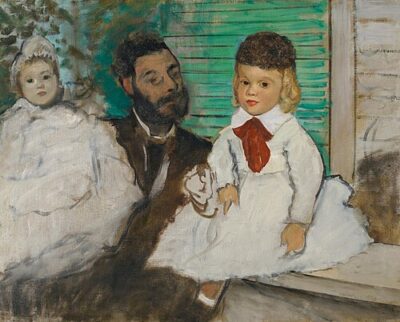
Count Lepic and His Daughters
Count Lepic and His Daughters is a painting by Edgar Degas. It came out in 1871.
- Came out
- 1871
- Created by
- Edgar Degas
- Genre
- family portrait
All 6 facts, and where they come from
Facts
6 facts · 0 confirmed by two sources · 4 cited · 2 from one source
Where this comes from
Papalocal keeps its own record. It started from these sources; what each one said is kept here as it was copied, so a change on their side never changes this page by itself. Tap one to read its version.
What Wikidata says · copied November 17, 2026 · revision 2567241174
- Described as
- painting by Edgar Degas
- Other names
- Ludovic Lepic and His Daughters
- What it is
- painting · 1 reference
- Created by
- Edgar Degas
- Genre
- family portrait
- Came out
- 1871 · 1 reference
- Owned by
- Galerie H. Fiquet · 1 reference; Paul Rosenberg (1938–1952) · 1 reference
- Wikipedias with a page
- 10
Wikidata item Q1016012 (wikidata.org/wiki/Q1016012), public domain (CC0). Copied 2026-11-17.
What Wikipedia says · copied November 17, 2026 · revision 1384706292
Ludovic Lepic and His Daughters (French: Ludovic Lepic et ses filles) is an oil painting on canvas completed ca. 1871 by the French artist Edgar Degas. The painting depicts Ludovic-Napoléon Lepic with his young daughters, Eylau and Jeanine. Degas also depicted Ludovic Lepic in the painting Place de la Concorde.
On February 10, 2008, the painting was stolen from Foundation E.G. Bührle in Zürich, Switzerland. It was recovered in April 2012 with slight damage.
From the Wikipedia article “Ludovic Lepic and His Daughters” (en.wikipedia.org/wiki/Ludovic_Lepic_and_His_Daughters), by its contributors, under CC BY-SA 4.0 (creativecommons.org/licenses/by-sa/4.0/). Copied 2026-11-17; not changed.
Confirmed Two sources agree. Cited One source, and it names where it got it. One source One source, without a reference of its own. Sources disagree The sources disagree. We show the best-supported value and keep theirs below.
Picture: Edgar Degas, via Wikimedia Commons · Public domain