
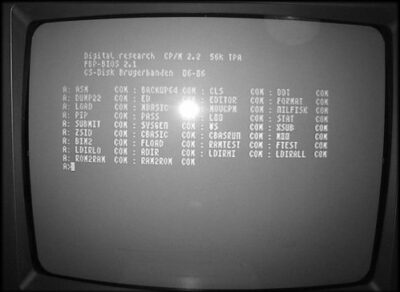
CP/M
CP/M is an operating system. It came out in 1974. It was created by Gary Kildall.
- Came out
- 1974
- Created by
- Gary Kildall
- Made by
- Digital Research
All 6 facts, and where they come from
Facts
6 facts · 0 confirmed by two sources · 0 cited · 6 from one source
Where this comes from
Papalocal keeps its own record. It started from these sources; what each one said is kept here as it was copied, so a change on their side never changes this page by itself. Tap one to read its version.
What Wikidata says · copied November 17, 2026 · revision 2563214109
- Described as
- operating system
- Other names
- Control Program/Monitor, Control Program for Microcomputers, Control Program / (for) Microcomputers
- What it is
- operating system
- Created by
- Gary Kildall
- Made by
- Digital Research; Gary Kildall
- Came out
- 1974
- Official website
- http://www.digitalresearch.biz/CPM.HTM
- Wikipedias with a page
- 45
Wikidata item Q219528 (wikidata.org/wiki/Q219528), public domain (CC0). Copied 2026-11-17.
What Wikipedia says · copied November 17, 2026 · revision 1386171237
CP/M, originally standing for Control Program/Monitor and later Control Program for Microcomputers, is a mass-market operating system created in 1974 for Intel 8080-based microcomputers by Gary Kildall of Digital Research, Inc. CP/M is a disk operating system and its purpose is to organize files on a magnetic storage medium, and to load and run programs stored on a disk. Initially confined to single-tasking on 8-bit processors and no more than 64 kilobytes of memory, later versions of CP/M added multi-user variations and were migrated to 16-bit processors.
CP/M's core components are the Basic Input/Output System (BIOS), the Basic Disk Operating System (BDOS), and the Console Command Processor (CCP). The BIOS consists of drivers that deal with devices and system hardware. The BDOS implements the file system and provides system services to applications. The CCP is the command-line interpreter and provides some built-in commands.
CP/M eventually became the de facto standard and the dominant operating system for microcomputers, in combination with the S-100 bus computers. This computer platform was widely used in business through the late 1970s and into the mid-1980s. CP/M increased the market size for both hardware and software by greatly reducing the amount of programming required to port an application to a new manufacturer's computer. An important driver of software innovation was the advent of (comparatively) low-cost microcomputers running CP/M, as independent programmers and hackers bought them and shared their creations in user groups. CP/M was eventually displaced in popularity by DOS following the 1981 introduction of the IBM PC.
From the Wikipedia article “CP/M” (en.wikipedia.org/wiki/CP/M), by its contributors, under CC BY-SA 4.0 (creativecommons.org/licenses/by-sa/4.0/). Copied 2026-11-17; not changed.
Confirmed Two sources agree. Cited One source, and it names where it got it. One source One source, without a reference of its own. Sources disagree The sources disagree. We show the best-supported value and keep theirs below.
Picture: Wikimedia Commons · CC BY-SA 3.0
