Critique of Pure Reason
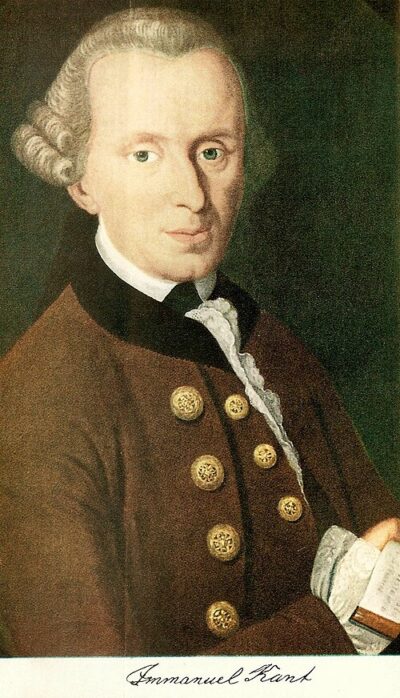
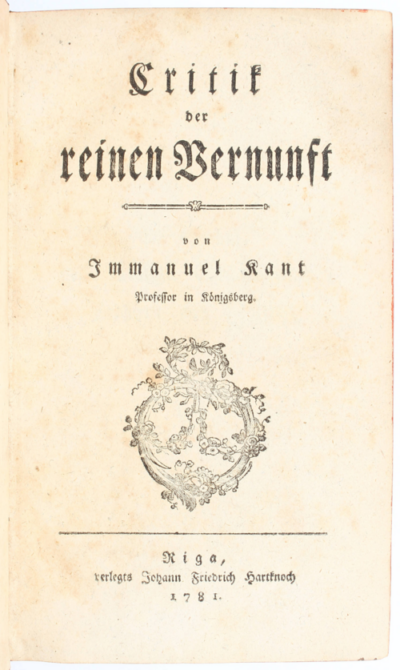
Critique of Pure Reason is a 1781 philosophical work by Immanuel Kant.
- Published
- 1781
- Written by
- Immanuel Kant
- Genre
- essay
- Country of origin
- Kingdom of Prussia
All 9 facts, and where they come from
Facts
9 facts · 0 confirmed by two sources · 0 cited · 9 from one source
Where this comes from
Papalocal keeps its own record. It started from these sources; what each one said is kept here as it was copied, so a change on their side never changes this page by itself. Tap one to read its version.
What Wikidata says · copied November 17, 2026 · revision 2562960969
- Described as
- 1781 philosophical work by Immanuel Kant
- What it is
- philosophical work; written work
- Written by
- Immanuel Kant
- Genre
- essay · 1 reference
- Published
- 1781
- Language
- German; English
- Country of origin
- Kingdom of Prussia
- Followed by
- Critique of Practical Reason
- Wikipedias with a page
- 60
Wikidata item Q220002 (wikidata.org/wiki/Q220002), public domain (CC0). Copied 2026-11-17.
What Wikipedia says · copied November 17, 2026 · revision 1384800422
The Critique of Pure Reason (German: Kritik der reinen Vernunft; 1781; second edition 1787) is a book by the German philosopher Immanuel Kant, in which he seeks to determine the limits and scope of metaphysics. Also referred to as Kant's "First Critique", it was followed by his Critique of Practical Reason (1788) and Critique of Judgment (1790). In the preface to the first edition, Kant explains that by a "critique of pure reason" he means a critique "of the faculty of reason in general, in respect of all knowledge after which it may strive independently of all experience" and that he aims to decide on "the possibility or impossibility of metaphysics".
Kant builds on the work of empiricist philosophers such as John Locke and David Hume, as well as rationalist philosophers such as René Descartes, Gottfried Wilhelm Leibniz and Christian Wolff. He expounds new ideas on the nature of space and time, and tries to provide solutions to Hume's skepticism about knowledge of the relation of cause and effect and Descartes's skepticism about knowledge of the external world. This is argued through the transcendental idealism of objects (as appearance) and their form of appearance. Kant regards the former "as mere representations and not as things in themselves", and the latter as "only sensible forms of our intuition, but not determinations given for themselves or conditions of objects as things in themselves". This grants the possibility of a priori knowledge, since objects as appearance "must conform to our cognition...which is to establish something about objects before they are given to us". Knowledge independent of experience Kant calls "a priori" knowledge, while knowledge obtained through experience is termed "a posteriori". According to Kant, a proposition is a priori if it is necessary and universal. A proposition is necessary if it is not false in any case and so cannot be rejected; rejection is contradiction. A proposition is universal if it is true in all cases, and so admits of no exceptions. Knowledge gained a posteriori through the senses, Kant argues, never imparts absolute necessity and universality, because we might encounter an exception.
Kant further elaborates on the distinction between "analytic" and "synthetic" judgments. A proposition is analytic if the content of the predicate-concept of the proposition is already contained within the subject-concept of that proposition. For example, Kant considers the proposition "All bodies are extended" analytic, since the predicate-concept ("extended") is already contained within—or "thought in"—the subject-concept ("body"). The distinctive character of analytic judgments is therefore that they can be known to be true simply by an analysis of the concepts contained in them; they are true by definition. In synthetic propositions, on the other hand, the predicate-concept is not already contained within the subject-concept. For example, Kant considers the proposition "All bodies are heavy" synthetic, since the concept "body" does not already contain within it the concept "weight". Synthetic judgments therefore add something to a concept, whereas analytic judgments only explain what is already contained in it.
Before Kant, philosophers held that all a priori knowledge must be analytic. Kant argues that our knowledge of mathematics, of the first principles of natural science, and of metaphysics, is both a priori and synthetic. The peculiar nature of this knowledge cries out for explanation. The central problem of the Critique is therefore to answer the question: "How are synthetic a priori judgments possible?" It is vital to metaphysics and to human reason, Kant argues, that the grounds of this kind of knowledge be explained.
Though it received little attention when it was first published, the Critique was later attacked by both empiricists and rationalists, and became a source of controversy. It has exerted an enduring influence on Western philosophy, and helped bring about the development of German idealism. The book is considered a culmination of several centuries of early modern philosophy and an inauguration of late modern philosophy.
From the Wikipedia article “Critique of Pure Reason” (en.wikipedia.org/wiki/Critique_of_Pure_Reason), by its contributors, under CC BY-SA 4.0 (creativecommons.org/licenses/by-sa/4.0/). Copied 2026-11-17; not changed.
Confirmed Two sources agree. Cited One source, and it names where it got it. One source One source, without a reference of its own. Sources disagree The sources disagree. We show the best-supported value and keep theirs below.
Picture: Wikimedia Commons · Public domain