De legibus
De legibus is a philosophical legal dialogue by Cicero.
- Written by
- Cicero
- Genre
- essay
- Country of origin
- Roman Republic
All 6 facts, and where they come from
Facts
6 facts · 0 confirmed by two sources · 0 cited · 6 from one source
Where this comes from
Papalocal keeps its own record. It started from these sources; what each one said is kept here as it was copied, so a change on their side never changes this page by itself. Tap one to read its version.
What Wikidata says · copied November 17, 2026 · revision 2517742036
- Described as
- philosophical legal dialogue by Cicero
- Other names
- M. Tullii Ciceronis De legibus, Cic. Leg.
- What it is
- literary work
- Written by
- Cicero
- Publisher
- Titus Pomponius Atticus
- Genre
- essay
- Language
- Classical Latin
- Country of origin
- Roman Republic · 1 reference
- Wikipedias with a page
- 20
Wikidata item Q1180701 (wikidata.org/wiki/Q1180701), public domain (CC0). Copied 2026-11-17.
What Wikipedia says · copied November 17, 2026 · revision 1384251595
On the Laws, also known by its Latin name De Legibus (abbr. De Leg.), is a Socratic dialogue written by Marcus Tullius Cicero during the last years of the Roman Republic. It bears the same name as Plato's famous dialogue, The Laws. Unlike his previous work De re publica, in which Cicero felt compelled to set the action in the times of Scipio Africanus Minor, Cicero wrote this work as a fictionalized dialogue between himself, his brother Quintus, and their mutual friend Titus Pomponius Atticus. The dialogue begins with the trio taking a leisurely stroll through Cicero's familial estate at Arpinum and they begin to discuss how the laws should be. Cicero uses this as a platform for expounding on his theories of natural law of harmony among the classes.
The three surviving books (out of an indeterminate number, although Jonathan Powell and Niall Rudd in their translation for Oxford seem to argue that it may have been six, to bring it in line with the number in de re publica), in order, expound on Cicero's beliefs in Natural Law, recasts the religious laws of Rome (in reality a rollback to the religious laws under the king Numa Pompilius) and finally talk of his proposed reforms to the Roman Constitution.
Whether or not the work was meant as an earnest plan of action is unknown. Cicero's basic conservative and traditionalist beliefs led him to imagine an idealized Rome before the Gracchi, with the classes still in harmony. From there, he reformed the worst points of the Roman constitution, while keeping the majority of it. Cicero's proposed constitution in Book Three must be seen as a renovation of the existing order, not a call to shatter the order and build anew. However, less than a decade after the accepted date for his beginning the manuscript, Julius Caesar crossed the Rubicon, launching the civil war that would end the Republic.
From the Wikipedia article “De Legibus” (en.wikipedia.org/wiki/De_Legibus), by its contributors, under CC BY-SA 4.0 (creativecommons.org/licenses/by-sa/4.0/). Copied 2026-11-17; not changed.
Confirmed Two sources agree. Cited One source, and it names where it got it. One source One source, without a reference of its own. Sources disagree The sources disagree. We show the best-supported value and keep theirs below.
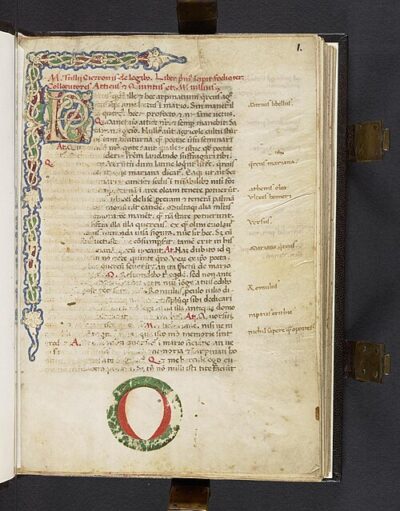
Picture: All information can be found at https://openn.library.upenn.edu/Data/0053/html/folger_ms_va88.html, via Wikimedia Commons · CC BY 1.0