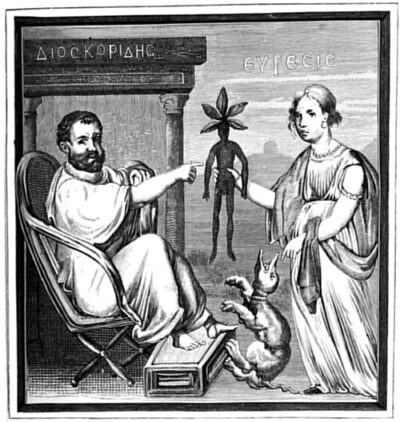
De materia medica
De materia medica is a 1st century pharmacopoeia of medicinal plants and medicines by Pedanius Dioscorides. It came out in 50.
- Published
- 50
- Written by
- Pedanius Dioscorides
- Genre
- treatise
- Country of origin
- Ancient Rome
All 6 facts, and where they come from
Facts
6 facts · 0 confirmed by two sources · 0 cited · 6 from one source
Where this comes from
Papalocal keeps its own record. It started from these sources; what each one said is kept here as it was copied, so a change on their side never changes this page by itself. Tap one to read its version.
What Wikidata says · copied November 17, 2026 · revision 2550146694
- Described as
- 1st century pharmacopoeia of medicinal plants and medicines by Pedanius Dioscorides
- Other names
- Περὶ ὕλης ἰατρικῆς
- What it is
- written work
- Written by
- Pedanius Dioscorides
- Genre
- treatise
- Published
- 50
- Language
- Latin
- Country of origin
- Ancient Rome · 1 reference
- Wikipedias with a page
- 21
Wikidata item Q3704131 (wikidata.org/wiki/Q3704131), public domain (CC0). Copied 2026-11-17.
What Wikipedia says · copied November 17, 2026 · revision 1385467132
De materia medica (Latin name for the Greek work Περὶ ὕλης ἰατρικῆς, Peri hulēs iatrikēs, both meaning "On Medical Material") is a pharmacopoeia of medicinal plants and the medicines that can be obtained from them. The five-volume work was written between 50 and 70 CE by Pedanius Dioscorides, a Greek physician in the Roman army. It was widely read for more than 1,500 years until supplanted by revised herbals in the Renaissance, making it one of the longest-lasting of all natural history and pharmacology books.
The work describes many drugs known to be effective, including aconite, aloes, colocynth, colchicum, henbane, opium and squill. In total, about 600 plants are covered, along with some animals and mineral substances, and around 1000 medicines made from them.
De materia medica was circulated as illustrated manuscripts, copied by hand, in Greek, Latin, and Arabic throughout the medieval period. From the 16th century onwards, Dioscorides' text was translated into Italian, German, Spanish, French, and into English in 1655. It served as the foundation for herbals in these languages by figures such as Leonhart Fuchs, Valerius Cordus, Lobelius, Rembert Dodoens, Carolus Clusius, John Gerard, and William Turner. Over time, these herbals incorporated increasing numbers of direct observations, gradually supplementing and eventually supplanting the classical text.
Several manuscripts and early printed versions of De materia medica survive, including the illustrated Vienna Dioscurides manuscript written in the original Greek in 6th-century Constantinople; it was used there by the Byzantines as a hospital text for just over a thousand years. Sir Arthur Hill saw a monk on Mount Athos still using a copy of Dioscorides to identify plants in 1934.
From the Wikipedia article “De materia medica” (en.wikipedia.org/wiki/De_materia_medica), by its contributors, under CC BY-SA 4.0 (creativecommons.org/licenses/by-sa/4.0/). Copied 2026-11-17; not changed.
Confirmed Two sources agree. Cited One source, and it names where it got it. One source One source, without a reference of its own. Sources disagree The sources disagree. We show the best-supported value and keep theirs below.
Picture: Wikimedia Commons: Dioscorides De Materia Medica Byzantium 15th century.jpg · See Commons file page