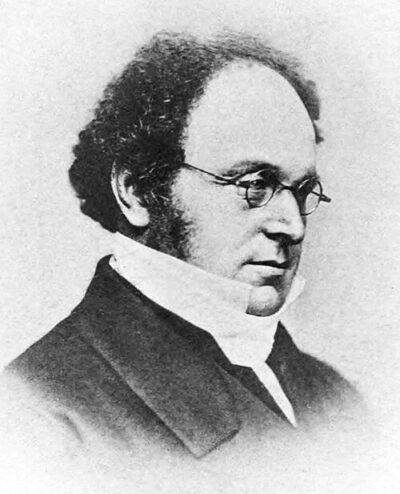
De Morgan's laws
De Morgan's laws is a pair of transformation rules that are both valid rules of inference.
All 3 facts, and where they come from
Facts
3 facts · 0 confirmed by two sources · 0 cited · 3 from one source
Where this comes from
Papalocal keeps its own record. It started from these sources; what each one said is kept here as it was copied, so a change on their side never changes this page by itself. Tap one to read its version.
What Wikidata says · copied November 17, 2026 · revision 2544687109
- Described as
- pair of transformation rules that are both valid rules of inference
- Other names
- DeMorgan’s theorem
- What it is
- theorem; rule of inference
- Named after
- Augustus De Morgan
- Wikipedias with a page
- 55
Wikidata item Q173300 (wikidata.org/wiki/Q173300), public domain (CC0). Copied 2026-11-17.
What Wikipedia says · copied November 17, 2026 · revision 1381583187
In propositional logic and Boolean algebra, De Morgan's laws, also known as De Morgan's theorem, are a pair of transformation rules that are both valid rules of inference. They are named after Augustus De Morgan, a 19th-century British mathematician. The rules allow the expression of conjunctions and disjunctions purely in terms of each other via negation.
The rules can be expressed in English as:The negation of "A and B" is the same as "not A or not B".
The negation of "A or B" is the same as "not A and not B".
orThe complement of the union of two sets is the same as the intersection of their complements
The complement of the intersection of two sets is the same as the union of their complements
ornot (A or B) = (not A) and (not B)
not (A and B) = (not A) or (not B)
where "A or B" is an "inclusive or" meaning at least one of A or B rather than an "exclusive or" that means exactly one of A or B.Another form of De Morgan's law is:
A−(B∪C)=(A−B)∩(A−C)A−(B∩C)=(A−B)∪(A−C)
Applications of the rules include simplification of logical expressions in computer programs and digital circuit designs. De Morgan's laws are an example of a more general concept of mathematical duality.
From the Wikipedia article “De Morgan's laws” (en.wikipedia.org/wiki/De_Morgan's_laws), by its contributors, under CC BY-SA 4.0 (creativecommons.org/licenses/by-sa/4.0/). Copied 2026-11-17; not changed.
Confirmed Two sources agree. Cited One source, and it names where it got it. One source One source, without a reference of its own. Sources disagree The sources disagree. We show the best-supported value and keep theirs below.
Picture: Wikimedia Commons: Demorganlaws.svg · See Commons file page