De Oratore
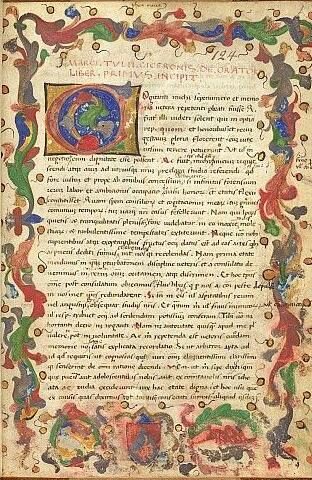
De Oratore is a rhetorical work by Cicero.
- Written by
- Cicero
- Genre
- dialogue
All 5 facts, and where they come from
Facts
5 facts · 0 confirmed by two sources · 2 cited · 3 from one source
Where this comes from
Papalocal keeps its own record. It started from these sources; what each one said is kept here as it was copied, so a change on their side never changes this page by itself. Tap one to read its version.
What Wikidata says · copied November 17, 2026 · revision 2552145765
- Described as
- rhetorical work by Cicero
- Other names
- Cic. de Orat.
- What it is
- literary work
- Written by
- Cicero · 1 reference
- Genre
- dialogue; essay
- Language
- Classical Latin · 1 reference
- Wikipedias with a page
- 21
Wikidata item Q246289 (wikidata.org/wiki/Q246289), public domain (CC0). Copied 2026-11-17.
What Wikipedia says · copied November 17, 2026 · revision 1381224796
De Oratore (On the Orator) is a dialogue written by Cicero in 55 BC. It is set in 91 BC, when Lucius Licinius Crassus dies, just before the Social War and the civil war between Marius and Sulla, during which Marcus Antonius, the other great orator of this dialogue, dies. During this year, the author faces a difficult political situation: after his return from exile in Dyrrachium (modern Albania), his house was destroyed by the gangs of Clodius in a time when violence was common. This was intertwined with the street politics of Rome.
Amidst the moral and political decadence of the state, Cicero wrote De Oratore to describe the ideal orator and imagine him as a moral guide of the state. He did not intend De Oratore as merely a treatise on rhetoric, but went beyond mere technique to make several references to philosophical principles. Cicero believed that the power of persuasion—the ability to verbally manipulate opinion in crucial political decisions—was a key issue and that in the hands of an unprincipled orator, this power would endanger the entire community.
As a consequence, moral principles can be taken either by the examples of noble men of the past or by the great Greek philosophers, who provided ethical ways to be followed in their teaching and their works.
The perfect orator shall be not merely a skilled speaker without moral principles, but both an expert of rhetorical technique and a man of wide knowledge in law, history, and ethical principles.
De Oratore is an exposition of issues, techniques, and divisions in rhetoric; it is also a parade of examples for several of them and it makes continuous references to philosophical concepts to be merged for a perfect result.
From the Wikipedia article “De Oratore” (en.wikipedia.org/wiki/De_Oratore), by its contributors, under CC BY-SA 4.0 (creativecommons.org/licenses/by-sa/4.0/). Copied 2026-11-17; not changed.
Confirmed Two sources agree. Cited One source, and it names where it got it. One source One source, without a reference of its own. Sources disagree The sources disagree. We show the best-supported value and keep theirs below.
Picture: Wikimedia Commons · Public domain