degree Fahrenheit
Degree Fahrenheit is a unit of temperature.
All 4 facts, and where they come from
Facts
4 facts · 0 confirmed by two sources · 0 cited · 4 from one source
Where this comes from
Papalocal keeps its own record. It started from these sources; what each one said is kept here as it was copied, so a change on their side never changes this page by itself. Tap one to read its version.
What Wikidata says · copied November 17, 2026 · revision 2570733908
- Described as
- unit of temperature
- Other names
- Fahrenheit, °F
- What it is
- unit of thermodynamic temperature; UCUM derived unit; unit without standard conversion to SI
- Named after
- Daniel Gabriel Fahrenheit
- Wikipedias with a page
- 96
Wikidata item Q42289 (wikidata.org/wiki/Q42289), public domain (CC0). Copied 2026-11-17.
What Wikipedia says · copied November 17, 2026 · revision 1385535101
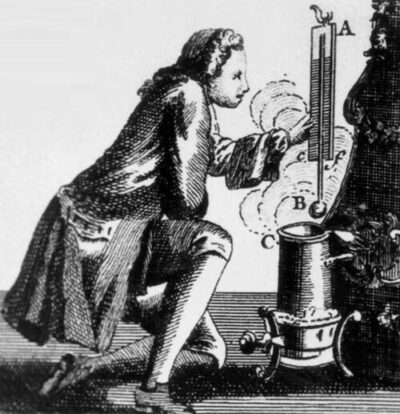
The Fahrenheit scale () is a temperature scale based on one proposed in 1724 by Daniel Gabriel Fahrenheit (1686–1736). It uses the degree Fahrenheit (symbol: °F) as the unit. Several accounts of how he originally defined his scale exist, but the original paper suggests the lower defining point, 0 °F, was established as the freezing temperature of a solution of brine made from a mixture of water, ice, and ammonium chloride (a salt). The other limit established was his best estimate of the average human body temperature, originally set at 90 °F, then 96 °F (about 2.6 °F less than the modern value because the scale was later redefined).
For much of the 20th century, the Fahrenheit scale was defined by two fixed points with a 180 °F separation: the temperature at which pure water freezes was defined as 32 °F and the boiling point of water was defined to be 212 °F, both at sea level and under standard atmospheric pressure. It is now formally defined using the Kelvin scale.
It continues to be used in the United States (including its unincorporated territories), its freely associated states in the Western Pacific (Palau, the Federated States of Micronesia and the Marshall Islands), which all use the United States National Weather Service, and one British Overseas Territory—the Cayman Islands.
Fahrenheit is still used alongside the Celsius scale in other countries that use the U.S. meteorological service, such as Antigua and Barbuda, Saint Kitts and Nevis, the Bahamas, and Belize. A handful of British Overseas Territories, including the Virgin Islands, Montserrat, Anguilla, and Bermuda, also still use both scales. All other countries now use Celsius ("centigrade" until 1948), which was developed 18 years after the Fahrenheit scale.
From the Wikipedia article “Fahrenheit” (en.wikipedia.org/wiki/Fahrenheit), by its contributors, under CC BY-SA 4.0 (creativecommons.org/licenses/by-sa/4.0/). Copied 2026-11-17; not changed.
Confirmed Two sources agree. Cited One source, and it names where it got it. One source One source, without a reference of its own. Sources disagree The sources disagree. We show the best-supported value and keep theirs below.