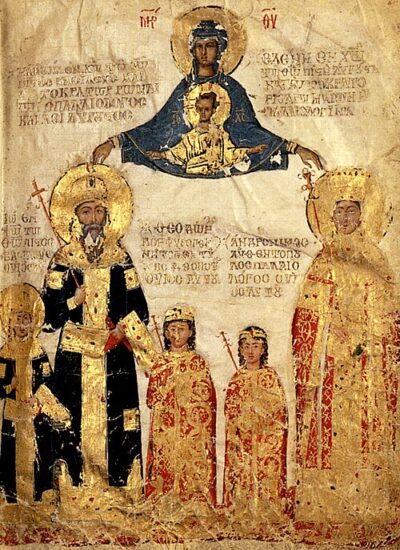
despot
Despot is a heir apparent to the emperor or senior court official.
All 3 facts, and where they come from
Facts
3 facts · 0 confirmed by two sources · 0 cited · 3 from one source
Where this comes from
Papalocal keeps its own record. It started from these sources; what each one said is kept here as it was copied, so a change on their side never changes this page by itself. Tap one to read its version.
What Wikidata says · copied November 17, 2026 · revision 2569506100
- Described as
- heir apparent to the emperor or senior court official
- Other names
- despotes
- What it is
- title of authority; position; noble title
- Wikipedias with a page
- 34
Wikidata item Q889870 (wikidata.org/wiki/Q889870), public domain (CC0). Copied 2026-11-17.
What Wikipedia says · copied November 17, 2026 · revision 1380449751
Despot or despotes was a senior Byzantine court title that was bestowed on the sons or sons-in-law of reigning emperors, and initially denoted the heir-apparent of the Byzantine emperor.
From Byzantium it spread throughout the late medieval Balkans and was also granted in the states under Byzantine cultural influence, such as the Latin Empire, the Second Bulgarian Empire, the Serbian Empire and its successor states (Bulgarian and Serbian: деспот, romanized: despót), and the Empire of Trebizond. With the political fragmentation of the period, the term gave rise to several principalities termed "despotates" which were ruled either as independent states or as appanages by princes bearing the title of despot; most notably the Despotate of Epirus, the Despotate of the Morea, the Despotate of Dobruja and the Serbian Despotate.
In modern usage, the word has taken a different meaning: "despotism" is a form of government in which a single entity rules with absolute power. The semantic shift undergone by the term is mirrored by "tyrant", an ancient Greek word that originally bore a neutral connotation, and the Latin "dictator", a constitutionally sanctioned office of the Roman Republic. In colloquial Modern Greek, the word is often used to refer to a bishop. In English, the feminine form of the title is despotess (from Ancient Greek: δεσπότισσα, romanized: despótissa; Bulgarian: деспотица, romanized: despotítsa; Serbian: деспотица/despotica), which denoted the spouse of a despot, but the transliterated traditional female equivalent of despotes, despoina (Ancient Greek: δέσποινα, romanized: déspoina, lit. 'lady of the house'), is also commonly used.
From the Wikipedia article “Despot (court title)” (en.wikipedia.org/wiki/Despot_(court_title)), by its contributors, under CC BY-SA 4.0 (creativecommons.org/licenses/by-sa/4.0/). Copied 2026-11-17; not changed.
Confirmed Two sources agree. Cited One source, and it names where it got it. One source One source, without a reference of its own. Sources disagree The sources disagree. We show the best-supported value and keep theirs below.
People connected 9
Held this office
 John IV of Trebizond (1417–1426)Emperor of Trebizond
 Alexios IV of Trebizond (1395–1417)Emperor of Trebizond
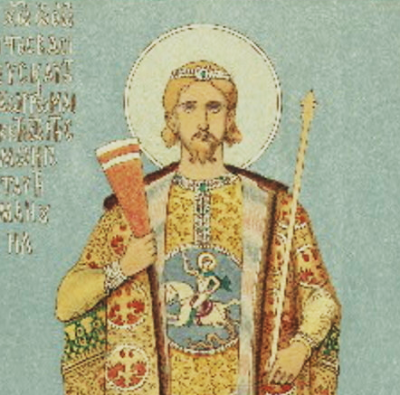 Manuel III of Trebizond (1377–1390)Emperor of Trebizond
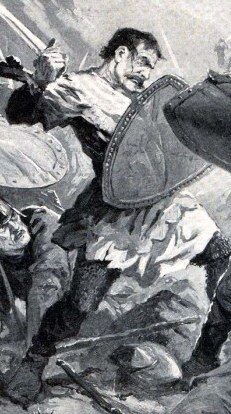 Michael Shishman of BulgariaBulgarian ruler
- IIvan Asen III of BulgariaBulgarian ruler
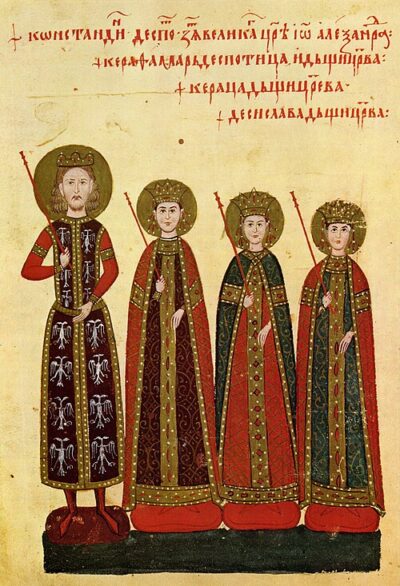 Constantine DragašSerbian lord in eastern Macedonia
- GGeorge I of BulgariaBulgarian ruler
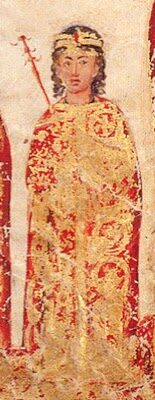 Andronikos Palaiologos, Lord of ThessalonicaByzantine governor