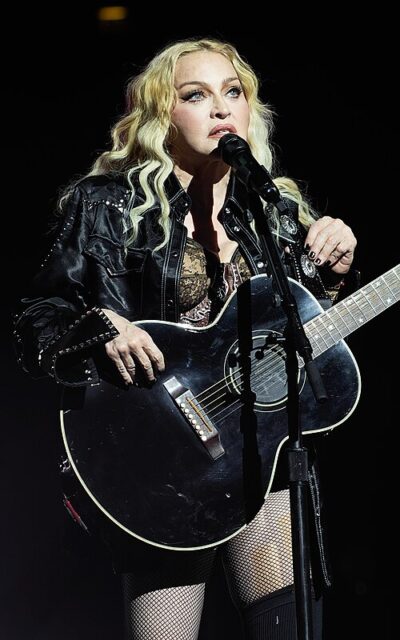
Die Another Day
Die Another Day is an original song written and composed by Madonna and Mirwais Ahmadzaï; James Bond song. It came out in 2002.
- Released
- 2002
- Performed by
- Madonna
- Genre
- dance-pop
All 7 facts, and where they come from
Facts
7 facts · 0 confirmed by two sources · 0 cited · 7 from one source
Where this comes from
Papalocal keeps its own record. It started from these sources; what each one said is kept here as it was copied, so a change on their side never changes this page by itself. Tap one to read its version.
What Wikidata says · copied November 16, 2026 · revision 2502011359
- Described as
- original song written and composed by Madonna and Mirwais Ahmadzaï; James Bond song
- What it is
- audio track
- Performed by
- Madonna
- Genre
- dance-pop · 1 reference
- Released
- 2002
- Language
- English
- Comes after
- What It Feels Like for a Girl · 1 reference
- Followed by
- American Life · 1 reference
- Wikipedias with a page
- 22
Wikidata item Q611419 (wikidata.org/wiki/Q611419), public domain (CC0). Copied 2026-11-16.
What Wikipedia says · copied November 16, 2026 · revision 1385915065
"Die Another Day" is a song by American singer Madonna, recorded as the theme for the 2002 James Bond film of the same name. Following the lukewarm commercial performance of Garbage's "The World Is Not Enough" (1999), Metro-Goldwyn-Mayer (MGM) Pictures sought a globally recognized artist for the franchise's next theme. Madonna, one of the most prominent figures in pop music, was selected as their top choice. She co-wrote and co-produced the track with Mirwais Ahmadzaï, with additional composition by Michel Colombier. Musically, "Die Another Day" blends electroclash and dance music with orchestral strings, and features lyrics exploring psychological themes such as ego destruction, including a reference to Sigmund Freud. The song plays during the film's opening sequence, in which James Bond—portrayed by Pierce Brosnan—is tortured in North Korea.
After an early leak in late September, "Die Another Day" was officially released in the United States on October 22, 2002, and in most European markets six days later. It was added to Madonna's ninth studio album, American Life (2003), and included on her compilation albums Celebration (2009) and Finally Enough Love: 50 Number Ones (2022). Upon release, critical reception was mixed to negative, with some reviewers ranking it among the weaker entries in the Bond theme catalogue. Nonetheless, the song received nominations for the Golden Globe Award for Best Original Song and two Grammy Awards: Best Dance Recording and Best Short Form Music Video.
Commercially, "Die Another Day" proved successful. In the United States, it peaked at number eight on the Billboard Hot 100—making it the first Bond theme to reach the chart's top ten since 1985—and was the best-selling dance single of both 2002 and 2003. It reached number one in Canada, Italy, and Spain, and entered the top ten in several other countries, including a peak at number three in the United Kingdom. The accompanying music video, directed by Swedish collective Traktor, features Madonna in Bond-inspired scenes, including a torture chamber and a fencing duel with her doppelgänger. With a production cost of $6.1 million ($10.92 million in 2025 dollars), it is the second most expensive video ever made. Its use of Jewish symbolism attracted controversy from some religious scholars. Madonna performed "Die Another Day" live on her Re-Invention (2004) and Celebration (2023–2024) concert tours, while a remixed version was used a video interlude on 2008―2009's Sticky & Sweet Tour.
From the Wikipedia article “Die Another Day (song)” (en.wikipedia.org/wiki/Die_Another_Day_(song)), by its contributors, under CC BY-SA 4.0 (creativecommons.org/licenses/by-sa/4.0/). Copied 2026-11-16; not changed.
Confirmed Two sources agree. Cited One source, and it names where it got it. One source One source, without a reference of its own. Sources disagree The sources disagree. We show the best-supported value and keep theirs below.
Picture: Wikimedia Commons: DiANotherDayNewYork (cropped).jpg · See Commons file page