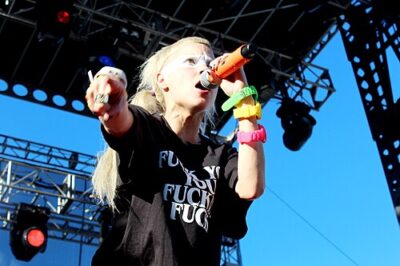
Die Antwoord
Die Antwoord is a South African rap-rave group. It was founded in 2008. It won the Libera Award for Video of the Year.
- Founded
- 2008
- Genre
- electronic dance music
- Record label
- Interscope Records
- Country of origin
- South Africa
All 9 facts, and where they come from
Facts
9 facts · 0 confirmed by two sources · 0 cited · 9 from one source
Where this comes from
Papalocal keeps its own record. It started from these sources; what each one said is kept here as it was copied, so a change on their side never changes this page by itself. Tap one to read its version.
What Wikidata says · copied November 17, 2026 · revision 2516792017
- Described as
- South African rap-rave group
- What it is
- musical group
- Genre
- electronic dance music · 1 reference; alternative hip-hop · 1 reference
- Country of origin
- South Africa · 1 reference
- Record label
- Interscope Records; Cherrytree Records
- Founded
- 2008
- Awards
- Libera Award for Video of the Year
- Official website
- https://home.dieantwoord.com/
- Wikipedias with a page
- 48
Wikidata item Q23376 (wikidata.org/wiki/Q23376), public domain (CC0). Copied 2026-11-17.
What Wikipedia says · copied November 17, 2026 · revision 1380530516
Die Antwoord (Afrikaans: [di ˈantvuərt]; Afrikaans for 'The Answer') is a South African hip hop duo formed in Cape Town in 2008. The duo consists of rappers Ninja and Yolandi Visser (also spelled Yo-Landi Visser and stylized as ¥o-Landi Vi$$er). Their music, a fusion of hip hop with rave music, is frequently produced by DJ Hi-Tek, and performed in both English and Afrikaans.
Die Antwoord rose to international fame in 2010 through the virality of the music video for their song "Enter the Ninja" on social media and through blog posts, soon signing to Interscope Records and reissuing their debut studio album, SOS, later that year. They parted ways with Interscope in 2011 and independently released their second studio album, Tension, in 2012. Their follow-up albums, the techno-influenced Donker Mag (2014) and the trap-based Mount Ninji and da Nice Time Kid (2016), became their most commercially successful releases in the United States, each topping Billboard's Top Dance/Electronic Albums chart. They said their fifth studio album, House of Zef, released in 2020, would be their last. However, it was followed by Zama Zama in 2026.
In film, Die Antwoord starred as fictionalized versions of themselves in both Harmony Korine's short film Umshini Wam (2011) and Neill Blomkamp's science fiction film Chappie (2015), while a documentary about them, Zef: The Story of Die Antwoord, was released in 2024. Die Antwoord's style revolves around the South African zef movement, which is largely based on working class Afrikaners and "white trash" motifs. They are known for their graphic and surreal music videos, energetic live performances—particularly at music festivals—and provocative public image. They have faced controversy since their inception for what critics have decried as cultural appropriation of numerous South African groups, the use of blackface in their music videos, homophobia, sexual assault allegations against Ninja, and abuse allegations from their adopted son. They have been regarded as one of the most internationally successful acts to come out of South Africa.
From the Wikipedia article “Die Antwoord” (en.wikipedia.org/wiki/Die_Antwoord), by its contributors, under CC BY-SA 4.0 (creativecommons.org/licenses/by-sa/4.0/). Copied 2026-11-17; not changed.
Confirmed Two sources agree. Cited One source, and it names where it got it. One source One source, without a reference of its own. Sources disagree The sources disagree. We show the best-supported value and keep theirs below.
Picture: Wikimedia Commons: Die Antwoord in LA 2010 07 17.jpg · See Commons file page