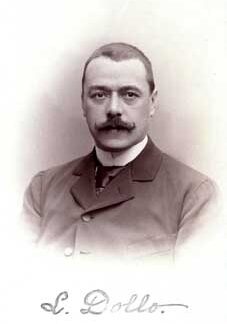
Dollo's law of irreversibility
Dollo's law of irreversibility is a hypothesis proposed by Louis Dollo which states evolution is not reversible.
All 3 facts, and where they come from
Facts
3 facts · 0 confirmed by two sources · 1 cited · 2 from one source
Where this comes from
Papalocal keeps its own record. It started from these sources; what each one said is kept here as it was copied, so a change on their side never changes this page by itself. Tap one to read its version.
What Wikidata says · copied November 18, 2026 · revision 2337856157
- Described as
- hypothesis proposed by Louis Dollo which states evolution is not reversible
- Other names
- Dollo's principle, Dollo's law
- What it is
- hypothesis; phylogenetic tree
- Named after
- Louis Dollo · 2 references
- Wikipedias with a page
- 21
Wikidata item Q1235791 (wikidata.org/wiki/Q1235791), public domain (CC0). Copied 2026-11-18.
What Wikipedia says · copied November 18, 2026 · revision 1383482322
Dollo's law of irreversibility (also known as Dollo's law and Dollo's principle), proposed in 1893 by Belgian paleontologist Louis Dollo states that, "an organism never returns exactly to a former state, even if it finds itself placed in conditions of existence identical to those in which it has previously lived ... it always keeps some trace of the intermediate stages through which it has passed."
The statement is often misinterpreted as claiming that evolution is not reversible, or that lost structures and organs cannot reappear in the same form by any process of devolution. According to Richard Dawkins, the law is "really just a statement about the statistical improbability of following exactly the same evolutionary trajectory twice (or, indeed, any particular trajectory), in either direction". Stephen Jay Gould suggested that irreversibility forecloses certain evolutionary pathways once broad forms have emerged: "[For example], once you adopt the ordinary body plan of a reptile, hundreds of options are forever closed, and future possibilities must unfold within the limits of inherited design."
This principle is classically applied to morphology, particularly of fossils, but may also be used to describe molecular events, such as individual mutations or gene losses.
From the Wikipedia article “Dollo's law of irreversibility” (en.wikipedia.org/wiki/Dollo's_law_of_irreversibility), by its contributors, under CC BY-SA 4.0 (creativecommons.org/licenses/by-sa/4.0/). Copied 2026-11-18; not changed.
Confirmed Two sources agree. Cited One source, and it names where it got it. One source One source, without a reference of its own. Sources disagree The sources disagree. We show the best-supported value and keep theirs below.