Douglas DC-3
Douglas DC-3 is a 1935 airliner family. It is based on Douglas DC-2.
- Country of origin
- United States
All 4 facts, and where they come from
Facts
4 facts · 0 confirmed by two sources · 0 cited · 4 from one source
Where this comes from
Papalocal keeps its own record. It started from these sources; what each one said is kept here as it was copied, so a change on their side never changes this page by itself. Tap one to read its version.
What Wikidata says · copied November 17, 2026 · revision 2559665407
- Described as
- 1935 airliner family
- Other names
- Gooney Bird, Douglas DC-3 Dakota, Dakota DC-3, DC-3, DC3
- What it is
- aircraft family
- Country of origin
- United States
- Based on
- Douglas DC-2 · 1 reference
- Comes after
- Douglas DC-2
- Wikipedias with a page
- 57
Wikidata item Q190211 (wikidata.org/wiki/Q190211), public domain (CC0). Copied 2026-11-17.
What Wikipedia says · copied November 17, 2026 · revision 1386022256
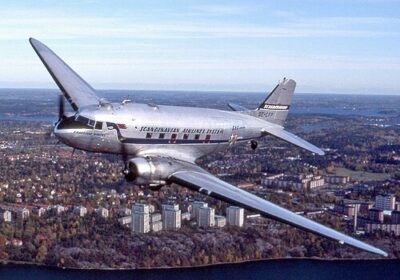
The Douglas DC-3 is a propeller-driven airliner that was manufactured by the Douglas Aircraft Company. It had a lasting effect on the airline industry from the 1930s through World War II.
It was developed as a larger, improved, 14-bed sleeper version of the Douglas DC-2.
It is a low-wing metal monoplane with conventional landing gear, powered by two radial piston engines of 1,000–1,200 hp (750–890 kW). Although the DC-3s originally built for civil service had the Wright R-1820 Cyclone, later civilian DC-3s used the Pratt & Whitney R-1830 Twin Wasp engine.
The DC-3 has a cruising speed of 207 mph (333 km/h), a capacity of 21 to 32 passengers or 6,000 lb (2,700 kg) of cargo, and a range of 1,500 mi (2,400 km); it can operate from short runways.
The DC-3 had many exceptional qualities compared to previous aircraft. It was fast, had a good range, was more reliable, and carried passengers in greater comfort. Before World War II, it pioneered many air travel routes. It was able to cross the continental United States from New York to Los Angeles in 18 hours, with only three stops.
It is one of the first airliners that could profitably carry only passengers without relying on mail subsidies. In 1939, at the peak of its dominance in the airliner market, around 90% of airline flights on the planet were by a DC-3 or one of its variants.
Following the war, the airliner market was flooded with surplus transport aircraft, and the DC-3 was no longer competitive because it was smaller and slower than aircraft built during the war. It was made obsolete on main routes by more advanced types such as the Douglas DC-4 and Convair 240, but the design proved adaptable and was still useful on less commercially demanding routes.
Civilian DC-3 production ended in 1943 at 607 aircraft. Military versions, including the C-47 Skytrain (the Dakota in British RAF service), and Soviet- and Japanese-built versions, brought total production to over 16,000.
Many continued to be used in a variety of niche roles; 2,000 DC-3s and military derivatives were estimated to be still flying in 2013; by 2017 more than 300 were still flying. As of 2023, it was estimated about 150 were still flying.
From the Wikipedia article “Douglas DC-3” (en.wikipedia.org/wiki/Douglas_DC-3), by its contributors, under CC BY-SA 4.0 (creativecommons.org/licenses/by-sa/4.0/). Copied 2026-11-17; not changed.
Confirmed Two sources agree. Cited One source, and it names where it got it. One source One source, without a reference of its own. Sources disagree The sources disagree. We show the best-supported value and keep theirs below.
Picture: Towpilot, via Wikimedia Commons · CC BY-SA 3.0