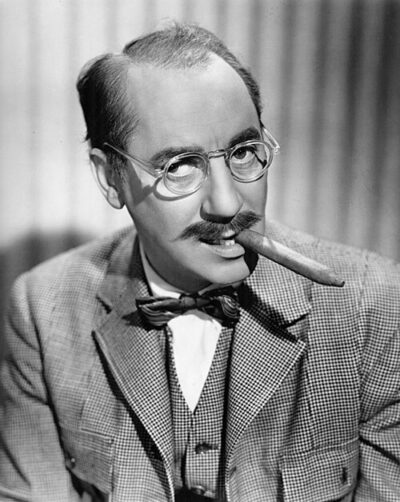
Duck Soup
Duck Soup is a 1933 film directed by Leo McCarey. It stars Groucho Marx, Harpo Marx and Chico Marx.
- Released
- 1933
- Directed by
- Leo McCarey
- Genre
- musical film
- Country of origin
- United States
All 21 facts, and where they come from
Facts
21 facts · 0 confirmed by two sources · 12 cited · 9 from one source
Where this comes from
Papalocal keeps its own record. It started from these sources; what each one said is kept here as it was copied, so a change on their side never changes this page by itself. Tap one to read its version.
What Wikidata says · copied November 16, 2026 · revision 2568708822
- Described as
- 1933 film directed by Leo McCarey
- What it is
- film
- Directed by
- Leo McCarey · 3 references
- Music by
- John Leipold
- Screenplay by
- Harry Ruby; Bert Kalmar
- Produced by
- Herman J. Mankiewicz
- Starring
- Groucho Marx · 3 references; Harpo Marx · 3 references; Chico Marx · 3 references; Zeppo Marx · 2 references; Margaret Dumont · 2 references; Louis Calhern · 2 references; Raquel Torres · 2 references; Edgar Kennedy · 2 references; William Worthington · 1 reference; Frederic Richard Sullivan
- Genre
- musical film · 3 references; comedy film · 2 references
- Released
- 1933 · 1 reference
- Original language
- English
- Country of origin
- United States
- Wikipedias with a page
- 45
Wikidata item Q1125566 (wikidata.org/wiki/Q1125566), public domain (CC0). Copied 2026-11-16.
What Wikipedia says · copied November 16, 2026 · revision 1381032769
Duck Soup is a 1933 American pre-Code musical comedy film written by Bert Kalmar and Harry Ruby (with additional dialogue by Arthur Sheekman and Nat Perrin) and directed by Leo McCarey. Released by Paramount Pictures on November 17, 1933, it stars the four Marx Brothers (Groucho, Harpo, Chico, and Zeppo) and also features Margaret Dumont, Louis Calhern, Raquel Torres and Edgar Kennedy.
Duck Soup was the final of the five Marx Brothers films released by Paramount Pictures. The film also marks Zeppo's last screen outing with his brothers. In the film, Groucho portrays Rufus T. Firefly, the newly installed president of the fictional country of Freedonia. Zeppo is his secretary, while Chico and Harpo are spies for the neighboring country of Sylvania. Relations between Firefly and the Sylvanian ambassador (Calhern) deteriorate during the film, eventually leading the two countries to war.
Compared to the Marx Brothers' previous films, Duck Soup was a financial disappointment, though not an outright box-office failure as is sometimes reported. The film opened to mixed reviews, although this by itself did not end the group's association with Paramount. Bitter contract disputes, including a threat by the Marxes to leave and found their own production company, soured their negotiations with the studio just as Duck Soup went into production. After the film fulfilled their contractual obligations to Paramount, the Marxes and the studio agreed to part ways.
While contemporaneous critics of Duck Soup felt it did not quite rise to the level of its predecessors, critical and popular opinion has evolved and the film has since achieved the status of a classic. Duck Soup is now widely considered to be a masterpiece of comedy and the Marx Brothers' finest film.
In 1990, the United States Library of Congress deemed Duck Soup "culturally, historically, or aesthetically significant" and selected it for preservation in the National Film Registry.
From the Wikipedia article “Duck Soup” (en.wikipedia.org/wiki/Duck_Soup), by its contributors, under CC BY-SA 4.0 (creativecommons.org/licenses/by-sa/4.0/). Copied 2026-11-16; not changed.
Confirmed Two sources agree. Cited One source, and it names where it got it. One source One source, without a reference of its own. Sources disagree The sources disagree. We show the best-supported value and keep theirs below.
Picture: Wikimedia Commons: Duck Soup 3.jpg · See Commons file page