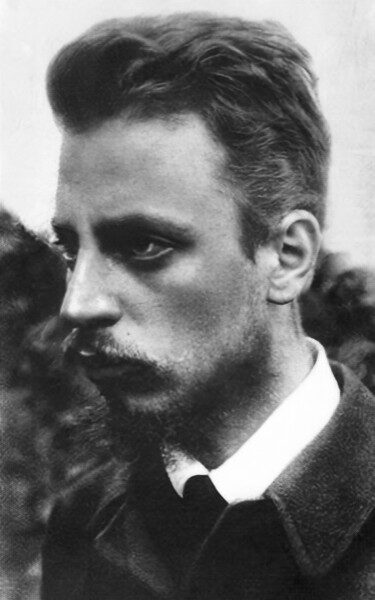
Duino Elegies
Duino Elegies is a 1923 cycle of poems by Rainer Maria Rilke.
- Published
- 1923
- Written by
- Rainer Maria Rilke
- Genre
- poetry
All 6 facts, and where they come from
Facts
6 facts · 0 confirmed by two sources · 1 cited · 5 from one source
Where this comes from
Papalocal keeps its own record. It started from these sources; what each one said is kept here as it was copied, so a change on their side never changes this page by itself. Tap one to read its version.
What Wikidata says · copied November 17, 2026 · revision 2489805766
- Described as
- 1923 cycle of poems by Rainer Maria Rilke
- Other names
- elegy
- What it is
- literary work
- Written by
- Rainer Maria Rilke
- Genre
- poetry
- Published
- 1923
- Language
- German · 1 reference
- Named after
- Duino
- Wikipedias with a page
- 22
Wikidata item Q688426 (wikidata.org/wiki/Q688426), public domain (CC0). Copied 2026-11-17.
What Wikipedia says · copied November 17, 2026 · revision 1384261987
The Duino Elegies (German: Duineser Elegien) are a collection of ten elegies written by the Bohemian-Austrian poet Rainer Maria Rilke. He was then "widely recognized as one of the most lyrically intense German-language poets", and began the elegies in 1912 while a guest of Princess Marie von Thurn und Taxis at Duino Castle on the Adriatic Sea. The poems were dedicated to the Princess upon their publication in 1923. During this ten-year period, the elegies languished incomplete for long stretches of time as Rilke had frequent bouts with severe depression—some of which were related to the events of World War I and being conscripted into military service.
Aside from brief periods of writing in 1913 and 1915, he did not return to the work until a few years after the war ended. With a sudden, renewed burst of frantic writing which he described as a "boundless storm, a hurricane of the spirit"—he completed the collection in February 1922 while staying at Château de Muzot in Veyras, Switzerland. After their publication in 1923, the Duino Elegies were soon recognized as his most important work.
The Duino Elegies are intensely religious, mystical poems that employ the symbolism of angels and salvation, but in a manner atypical of Christian interpretations. Rilke begins the first elegy in an invocation of philosophical despair, asking: "Who, if I cried out, would hear me among the angelic orders?" (Wer, wenn ich schriee, hörte mich denn aus der Engel Ordnungen?) and later declares that "each single angel is terrifying" (Jeder Engel ist schrecklich). While labelling of these poems as "elegies" would typically imply melancholy and lamentation, many passages are marked by their positive energy.
Together, the Duino Elegies are described as a metamorphosis of Rilke's "ontological torment" and an "impassioned monologue about coming to terms with human existence", discussing themes of "the limitations and insufficiency of the human condition and fractured human consciousness ... man's loneliness, the perfection of the angels, life and death, love and lovers, and the task of the poet". Rilke's poetry, and the Duino Elegies in particular, influenced many of the poets and writers of the twentieth century. In popular culture, his work is frequently quoted on the subject of love or of angels and referenced in television programs, motion pictures, music and other artistic works, in New Age philosophy and theology, and in self-help books.
From the Wikipedia article “Duino Elegies” (en.wikipedia.org/wiki/Duino_Elegies), by its contributors, under CC BY-SA 4.0 (creativecommons.org/licenses/by-sa/4.0/). Copied 2026-11-17; not changed.
Confirmed Two sources agree. Cited One source, and it names where it got it. One source One source, without a reference of its own. Sources disagree The sources disagree. We show the best-supported value and keep theirs below.
Picture: Wikimedia Commons: Rilke Duineser Elegien Titel.jpg · See Commons file page