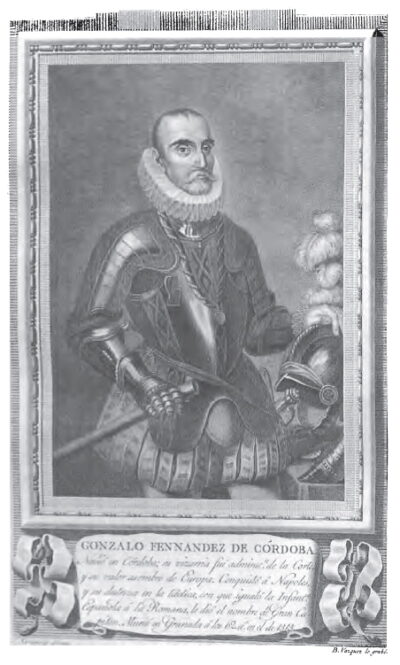
Duke of Andría
The Duke of Andría is a dukedom of Spain.
All 2 facts, and where they come from
Facts
2 facts · 0 confirmed by two sources · 0 cited · 2 from one source
Where this comes from
Papalocal keeps its own record. It started from these sources; what each one said is kept here as it was copied, so a change on their side never changes this page by itself. Tap one to read its version.
What Wikidata says · copied November 17, 2026 · revision 2399028952
- Described as
- dukedom of Spain
- What it is
- nobility of Spain; noble title
- Wikipedias with a page
- 1
Wikidata item Q112182613 (wikidata.org/wiki/Q112182613), public domain (CC0). Copied 2026-11-17.
What Wikipedia says · copied November 17, 2026 · revision 1321143338
Duke of Andría (Spanish: Duque de Andría) is a hereditary title in the Peerage of Spain, accompanied by the dignity of Grandee and granted in 1507 by Ferdinand II to "El Gran Capitán" (Gonzalo Fernández de Córdoba), a general who negotiated the Surrender of Granada and led the Spanish to victory in the Italian Wars. It is a victory title, making reference to the town of Andria in the Province of Bari, Italy.
After the death of the 1st Duke, Ferdinand II prohibited the inheritance and use of the Dukedoms of Andría, Terranova and Montalto and thus the title was unofficially held by some of his Italian descendants for more than 300 years. However, in 1904, Alfonso XIII formally rehabilitated the title on behalf of José Alfonso de Bustos, a legitimate descendant of the 1st Duke, who legally became the 2nd Duke of Andría.
From the Wikipedia article “Duke of Andría” (en.wikipedia.org/wiki/Duke_of_Andría), by its contributors, under CC BY-SA 4.0 (creativecommons.org/licenses/by-sa/4.0/). Copied 2026-11-17; not changed.
Confirmed Two sources agree. Cited One source, and it names where it got it. One source One source, without a reference of its own. Sources disagree The sources disagree. We show the best-supported value and keep theirs below.