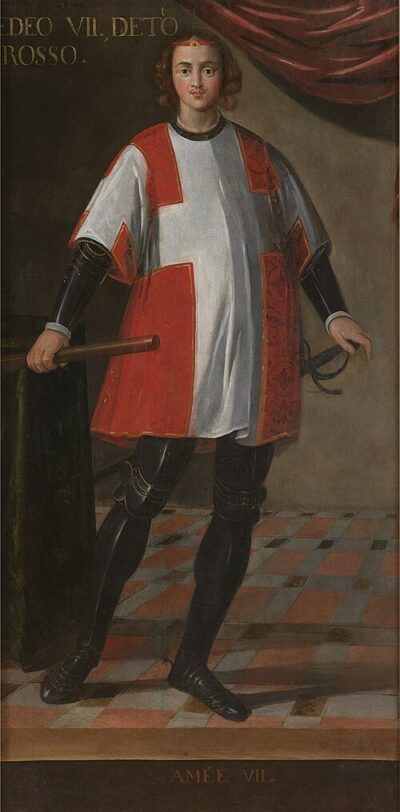
Duke of Aosta
The Duke of Aosta is an Italian noble title.
- Country
- Kingdom of Italy
All 2 facts, and where they come from
Facts
2 facts · 0 confirmed by two sources · 0 cited · 2 from one source
Where this comes from
Papalocal keeps its own record. It started from these sources; what each one said is kept here as it was copied, so a change on their side never changes this page by itself. Tap one to read its version.
What Wikidata says · copied November 17, 2026 · revision 2539110270
- Described as
- Italian noble title
- Other names
- Savoia-Aosta
- What it is
- hereditary title
- Country
- Kingdom of Italy
- Wikipedias with a page
- 14
Wikidata item Q429367 (wikidata.org/wiki/Q429367), public domain (CC0). Copied 2026-11-17.
What Wikipedia says · copied November 17, 2026 · revision 1335121340
Duke of Aosta (Italian: Duca d'Aosta; French: Duc d'Aoste) was a title in the Italian nobility. It was established in the 13th century when Frederick II, Holy Roman Emperor, made the County of Aosta a duchy. The region was part of the Savoyard state and the title was granted to various princes of the House of Savoy, second sons of the reigning king of Sardinia or king of Italy.
The title was re-created in 1845 for Prince Amadeo, son of Victor Emmanuel II, and thereafter held by him and his descendants until the abolition of the Italian monarchy in 1946. Two holders briefly served as kings of European countries – Prince Amadeo ruled as king of Spain from 1870 to 1873, while his grandson Prince Aimone was titular king of Croatia from 1941 to 1943 during the Italian-backed fascist regime.
The subsidiary titles of the Duke of Aosta were Prince della Cisterna and of Belriguardo, Marquess of Voghera, and Count of Ponderano, originating from the heritage of Maria Vittoria dal Pozzo, the mother of Duke Emanuele Filiberto. Ponderano was created in 1559, Voghera in 1618; Cisterna and Belriguardo as princely in 1670.
From the Wikipedia article “Duke of Aosta” (en.wikipedia.org/wiki/Duke_of_Aosta), by its contributors, under CC BY-SA 4.0 (creativecommons.org/licenses/by-sa/4.0/). Copied 2026-11-17; not changed.
Confirmed Two sources agree. Cited One source, and it names where it got it. One source One source, without a reference of its own. Sources disagree The sources disagree. We show the best-supported value and keep theirs below.