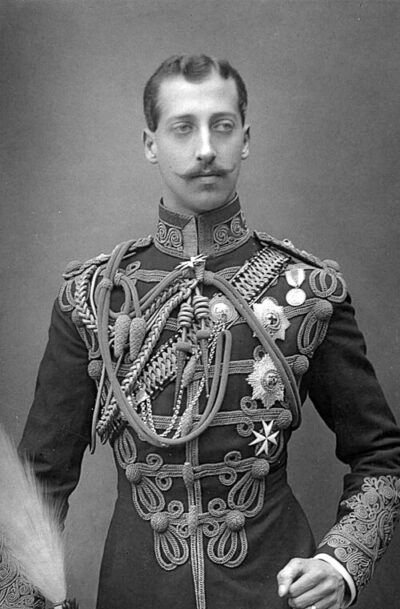
Duke of Clarence and Avondale
The Duke of Clarence and Avondale is a title in the peerage of the United Kingdom. It was created in 1890.
- Country
- United Kingdom
- Created
- May 24, 1890
All 4 facts, and where they come from
Facts
4 facts · 0 confirmed by two sources · 0 cited · 4 from one source
Where this comes from
Papalocal keeps its own record. It started from these sources; what each one said is kept here as it was copied, so a change on their side never changes this page by itself. Tap one to read its version.
What Wikidata says · copied November 17, 2026 · revision 2456958563
- Described as
- title in the peerage of the United Kingdom
- What it is
- noble title
- Created
- May 24, 1890 · 1 reference
- Ended
- January 14, 1892 · 1 reference
- Country
- United Kingdom
- Wikipedias with a page
- 10
Wikidata item Q17986516 (wikidata.org/wiki/Q17986516), public domain (CC0). Copied 2026-11-17.
What Wikipedia says · copied November 17, 2026 · revision 1382678529
Duke of Clarence and Avondale was a title awarded to Prince Albert Victor, a grandson of Queen Victoria, in the Peerage of the United Kingdom.
Whilst there had previously been several creations of Dukes of Clarence (and one Duke of Clarence and St Andrews), the sole creation of a dukedom of Clarence and Avondale was for Albert Victor, the eldest son of the Prince of Wales (later King Edward VII). This was the last royal dukedom to be created with two territorial designations. The title "Avondale" refers to the valley of the Avon Water, Scotland.
The Duke died of pneumonia in 1892 before his planned marriage so the title became extinct. He is buried in the Albert Memorial Chapel adjoining St George's Chapel, Windsor, beneath an Art Nouveau memorial designed by Sir Alfred Gilbert.
From the Wikipedia article “Duke of Clarence and Avondale” (en.wikipedia.org/wiki/Duke_of_Clarence_and_Avondale), by its contributors, under CC BY-SA 4.0 (creativecommons.org/licenses/by-sa/4.0/). Copied 2026-11-17; not changed.
Confirmed Two sources agree. Cited One source, and it names where it got it. One source One source, without a reference of its own. Sources disagree The sources disagree. We show the best-supported value and keep theirs below.