Dyskolos
Dyskolos is an ancient Greek comedy by Menander.
- Written by
- Menander
- Genre
- New Comedy
All 4 facts, and where they come from
Facts
4 facts · 0 confirmed by two sources · 0 cited · 4 from one source
Where this comes from
Papalocal keeps its own record. It started from these sources; what each one said is kept here as it was copied, so a change on their side never changes this page by itself. Tap one to read its version.
What Wikidata says · copied November 17, 2026 · revision 2558019856
- Described as
- ancient Greek comedy by Menander
- Other names
- The Misanthrope, Dyscolus, Misanthrope, The Grouch, The Bad-tempered Man, Old Cantankerous
- What it is
- dramatic work
- Written by
- Menander
- Genre
- New Comedy
- Language
- Ancient Greek
- Wikipedias with a page
- 21
Wikidata item Q1248766 (wikidata.org/wiki/Q1248766), public domain (CC0). Copied 2026-11-17.
What Wikipedia says · copied November 17, 2026 · revision 1359934771
Dyskolos (Greek: Δύσκολος, pronounced [dýskolos], translated as The Grouch, The Misanthrope, The Curmudgeon, The Bad-tempered Man or Old Cantankerous) is an Ancient Greek comedy by Menander, the only one of his plays, and of the whole New Comedy, that has survived in nearly complete form. It was first presented at the Lenaian festival in Athens in 316 BCE, where it won Menander the first prize.
It was long known only through fragmentary quotations; but a papyrus manuscript of the nearly complete Dyskolos, dating to the 3rd century, was recovered in Egypt in 1952 and forms part of the Bodmer Papyri and Oxyrhynchus Papyri. The play was published in 1958 by Victor Martin.
The story of the play concerns a rich young nobleman, Sostratos, who falls in love at first sight with a village peasant girl and decides to marry her. Unfortunately, her father, Knemon, is reclusive, notoriously bad-tempered, and next to impossible to approach. Eventually, after winning over Knemon's stepson Gorgias, showing his own work ethic, and helping to rescue Knemon from the well he has absurdly fallen into, Sostratos wins Knemon over and receives his blessing to marry his daughter. Sostratos also persuades his own father, Kallippides, to bless the betrothal of his own daughter to Gorgias. At the end of the play, Knemon is dragged kicking and screaming by the other characters to join the party for his daughter's wedding. As explained in the prologue, the events of the play are secretly orchestrated by the god Pan who wishes to reward the religious piety of Knemon's daughter and force Knemon, against his will, to experience a redemption arc.
The Dyskolos inspired Molière, who knew only the theme of the play, as it had not yet been found, in his writing of The Misanthrope (1666).
From the Wikipedia article “Dyskolos” (en.wikipedia.org/wiki/Dyskolos), by its contributors, under CC BY-SA 4.0 (creativecommons.org/licenses/by-sa/4.0/). Copied 2026-11-17; not changed.
Confirmed Two sources agree. Cited One source, and it names where it got it. One source One source, without a reference of its own. Sources disagree The sources disagree. We show the best-supported value and keep theirs below.
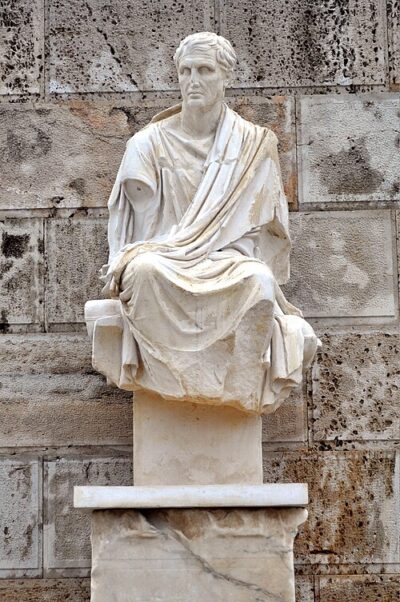
Picture: Wikimedia Commons: New Comedy Period (Ancient Greece) (14610356907).jpg · See Commons file page