Earl of Northumbria
Earl of Northumbria is a noble title in England. It is an office of earldom of Northumbria.
- Office of
- earldom of Northumbria
All 2 facts, and where they come from
Facts
2 facts · 0 confirmed by two sources · 0 cited · 2 from one source
Where this comes from
Papalocal keeps its own record. It started from these sources; what each one said is kept here as it was copied, so a change on their side never changes this page by itself. Tap one to read its version.
What Wikidata says · copied November 17, 2026 · revision 2539884379
- Described as
- noble title in England
- What it is
- noble title
- Office of
- earldom of Northumbria
- Wikipedias with a page
- 16
Wikidata item Q1250180 (wikidata.org/wiki/Q1250180), public domain (CC0). Copied 2026-11-17.
What Wikipedia says · copied November 17, 2026 · revision 1361113835
Earl of Northumbria or Ealdorman of Northumbria was a title in the late Anglo-Saxon, Anglo-Scandinavian and early Anglo-Norman period in England. The ealdordom was a successor of the Norse Kingdom of York.
In the seventh century, the Anglo-Saxon kingdoms of Bernicia and Deira were united in the Kingdom of Northumbria, but this was destroyed by the Vikings in 867. Southern Northumbria, the former Deira, then became the Viking kingdom of York, while the rulers of Bamburgh commanded territory to the North of the Tees, roughly equivalent to the northern kingdom of Bernicia. Scandinavian domination came to an end when Eadred's forces killed Eric Bloodaxe at the Battle of Stainmore in 954.
The whole area was then governed by earls, from the local nobility, who were appointed by the King of England to rule Northumbria in his stead. The honorific title "Earl" was Anglo-Scandinavian in origin. At the time of the Norman Conquest Northumbria was one of only seven Earldoms for all of England. The title of Earl was the highest rank below the king. In English counties Shire-Reeves would often govern a smaller area underneath the earl and where there was no earl in charge the king would appoint a Shire-Reeve to govern in his place.
In 1006 Uhtred the Bold, ruler of Bamburgh, by command of Æthelred the Unready became ealdorman in the south, temporarily re-uniting much of the area of Northumbria into a single jurisdiction. Uhtred was murdered in 1016, and Cnut then appointed Norwegian Eric of Hlathir to the Earldom of Northumbria, but Uhtred's dynasty held onto Bamburgh. Although a Scandinavian king ruled all of England, Northumbria was not well integrated into the rest of the country.
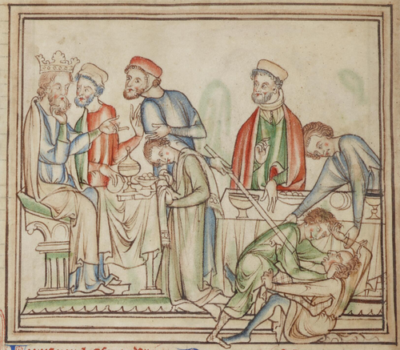
Siward became the last Scandinavian Earl of Northumbria when he succeeded Erik in about 1033. He governed for 22 years without difficulty. On Siward's death in 1055, the king of England, Edward the Confessor, chose a West Saxon to govern Yorkshire, in place of Siward's son, Waltheof. Edward's choice, Tostig Godwinson, was unpopular with locals. In 1065 Tostig was deposed by the northern nobility and replaced with Morcar (the brother of Edwin of Mercia). The northerners choice of new earl was accepted by Edward as well as by Tostig's brother Harold Godwinson.
After Edward the Confessor's death in 1066, Harold became King of England. In September 1066 Tostig, angry at Harold's betrayal, was back on the scene this time with his ally, Harald Hardrada of Norway. On 20 September 1066 the allies defeated, the northern earls, Morcar and Edwin at the Battle of Fulford although eventually they were defeated and killed, by Harold Godwinson, at the Battle of Stamford Bridge.
After the Norman Conquest the region was divided into multiple smaller baronies, one of which was the earldom of Northumberland, with others like the earldoms of York and numerous autonomous liberties such as the County Palatine of Durham and Liberty of Tynedale.
From the Wikipedia article “Earl of Northumbria” (en.wikipedia.org/wiki/Earl_of_Northumbria), by its contributors, under CC BY-SA 4.0 (creativecommons.org/licenses/by-sa/4.0/). Copied 2026-11-17; not changed.
Confirmed Two sources agree. Cited One source, and it names where it got it. One source One source, without a reference of its own. Sources disagree The sources disagree. We show the best-supported value and keep theirs below.