Eiffel Tower
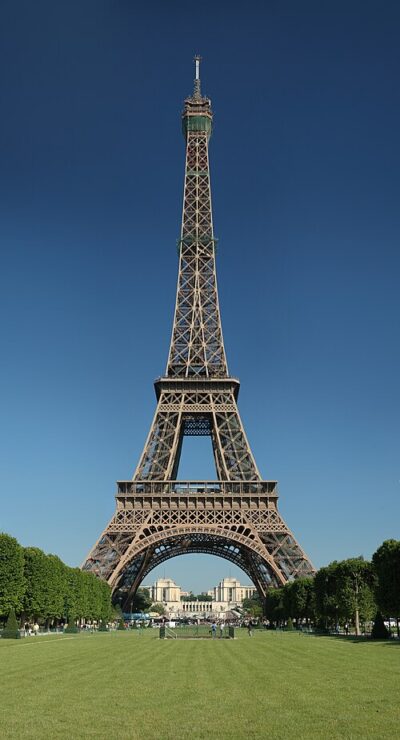
Eiffel Tower is a tower located on the Champ de Mars in Paris, France. It came out in 1887.
- Came out
- January 28, 1887
All 10 facts, and where they come from
Facts
10 facts · 0 confirmed by two sources · 4 cited · 6 from one source
Where this comes from
Papalocal keeps its own record. It started from these sources; what each one said is kept here as it was copied, so a change on their side never changes this page by itself. Tap one to read its version.
What Wikidata says · copied November 17, 2026 · revision 2561797302
- Described as
- tower located on the Champ de Mars in Paris, France
- Other names
- the Eiffel Tower, La Tour Eiffel
- What it is
- lattice tower · 1 reference; observation tower; architectural landmark
- Came out
- January 28, 1887 · 1 reference
- Located in
- 7th arrondissement of Paris · 2 references
- Country
- France · 2 references
- Owned by
- Government of the French Republic (1889–); municipality of Paris · 1 reference
- Named after
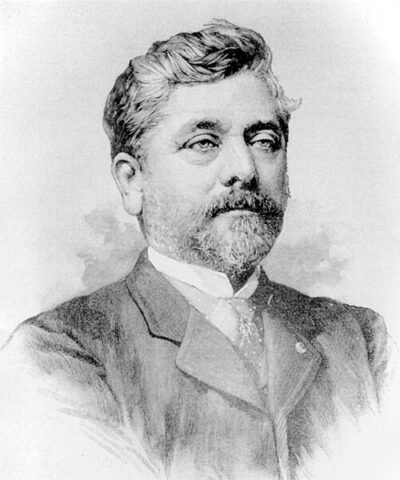
- Gustave Eiffel · 1 reference
- Official website
- https://www.toureiffel.paris
- Wikipedias with a page
- 191
Wikidata item Q243 (wikidata.org/wiki/Q243), public domain (CC0). Copied 2026-11-17.
What Wikipedia says · copied November 17, 2026 · revision 1385997089
The Eiffel Tower ( EYE-fəl; French: Tour Eiffel [tuʁ ɛfɛl] ) is a lattice tower on the Champ de Mars in Paris, France. It is named after the engineer Gustave Eiffel, whose company designed and built the tower from 1887 to 1889.
Locally nicknamed "La dame de fer" (French for "Iron Lady") for its use of wrought iron, it was constructed as the centrepiece of the 1889 World's Fair, and to crown the centennial anniversary of the French Revolution. Although initially criticised by some of France's leading artists and intellectuals for its design, it has since become a global cultural icon of France and one of the most recognisable structures in the world. The tower received 5,889,000 visitors in 2022. The Eiffel Tower is the most visited monument with an entrance fee in the world: 6.91 million people ascended it in 2015. It was designated a monument historique in 1964, and was named part of a UNESCO World Heritage Site ("Paris, Banks of the Seine") in 1991.
The tower is 330 metres (1,083 ft) tall, about the same height as an 81-storey building, and the tallest structure in Paris. Its base is square, measuring 125 metres (410 ft) on each side. During its construction, the Eiffel Tower surpassed the Washington Monument to become by far the tallest human-made structure in the world, a title it held for 41 years until the Chrysler Building in New York City was finished in 1930. It was the first structure in the world to surpass both the 200-metre and 300-metre mark in height. Due to the addition of a broadcasting aerial at the top of the tower in 1957, it is now taller than the Chrysler Building by 11 metres (36 ft). Excluding transmitters, the Eiffel Tower is the second tallest free-standing structure in France after the Millau Viaduct.
The tower has three levels for visitors, with restaurants on the first and second levels. The top level's upper platform is 276 m (906 ft) above the ground—the highest public observation deck in the European Union. Tickets can be purchased to ascend by stairs or lift to the first and second levels. The climb from ground level to the first level is over 300 steps, as is the climb from the first level to the second, making the entire ascent a 600-step climb. Although there is a staircase to the top level, it is usually accessible only by lift. On this top, third level, is a private apartment built for Gustave Eiffel, who decorated it with furniture made by Jean Lachaise and invited friends such as Thomas Edison.
From the Wikipedia article “Eiffel Tower” (en.wikipedia.org/wiki/Eiffel_Tower), by its contributors, under CC BY-SA 4.0 (creativecommons.org/licenses/by-sa/4.0/). Copied 2026-11-17; not changed.
Confirmed Two sources agree. Cited One source, and it names where it got it. One source One source, without a reference of its own. Sources disagree The sources disagree. We show the best-supported value and keep theirs below.
Picture: Benh LIEU SONG, via Wikimedia Commons · Public domain