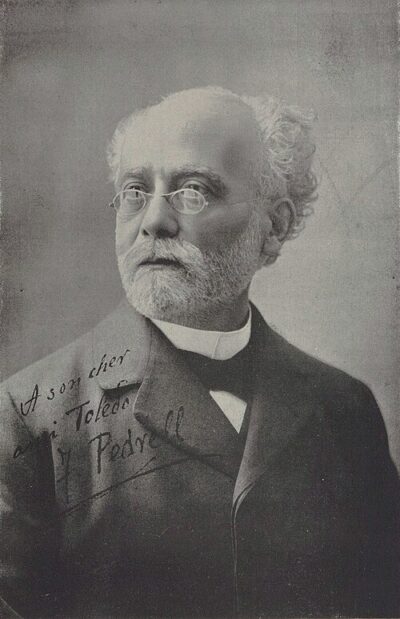
Els Pirineus
Els Pirineus is a 1902 opera by Felip Pedrell.
- Released
- 1902
- Genre
- opera
- Country of origin
- Spain
All 6 facts, and where they come from
Facts
6 facts · 0 confirmed by two sources · 0 cited · 6 from one source
Where this comes from
Papalocal keeps its own record. It started from these sources; what each one said is kept here as it was copied, so a change on their side never changes this page by itself. Tap one to read its version.
What Wikidata says · copied November 18, 2026 · revision 2311410263
- Described as
- 1902 opera by Felip Pedrell
- What it is
- dramatico-musical work
- Music by
- Felip Pedrell
- Genre
- opera
- Released
- 1902
- Language
- Italian
- Country of origin
- Spain
- Wikipedias with a page
- 4
Wikidata item Q5409906 (wikidata.org/wiki/Q5409906), public domain (CC0). Copied 2026-11-18.
What Wikipedia says · copied November 18, 2026 · revision 1359581907
Els Pirineus (in Spanish: Los Pirineos; in English: The Pyrenees) is an opera in three acts and a prologue with music by Felipe Pedrell and libretto based on the trilogy Els Pirineus (The Pyrenees) by Víctor Balaguer (1892). It premiered, in Italian, on January 4, 1902, at the Gran Teatro del Liceo.
In Spain, musical nationalism appeared during the 19th century as a reaction to German and Italian romanticism, which conditioned European opera. Felipe Pedrell led the efforts to achieve a Spanish opera, a task in which he was seconded by Ruperto Chapí and Tomás Bretón, among others. After the success of the revival of his Italian-language work L'ultimo abenzeraggio (in English: The Last Abencerrage) in 1889, the composer from Tortosa received numerous incentives to return to composing operas. Pedrell intended to reply to Bretón's opera Lovers of Teruel.
The opera was conceived from the beginning as a tragedy that Balaguer wrote in the Casa de Santa Teresa, his residence, next to the current Víctor Balaguer Museum-Library in Villanueva y Geltrú. Pedrell, for his part, began to work on the composition of the opera in 1890, and while he was shaping what would become the first two acts, Balaguer expanded his work on Albigensians, troubadours, and inquisitors with what would become the prologue and third act of the opera. Within months, Pedrell outlined the idea of the trilogy with a prologue, perhaps because of certain affinities with the Wagnerian tetralogy Der Ring des Nibelungen (in English: The Ring of the Nibelung), but with the intention of reforming lyric drama and creating a Hispanic lyric school. The Wagnerian character of the score is not so evident, or at least so exclusive, as one can also trace the influences of the Italian composers of the time as well as the French grand opéra.
From the Wikipedia article “Els Pirineus” (en.wikipedia.org/wiki/Els_Pirineus), by its contributors, under CC BY-SA 4.0 (creativecommons.org/licenses/by-sa/4.0/). Copied 2026-11-18; not changed.
Confirmed Two sources agree. Cited One source, and it names where it got it. One source One source, without a reference of its own. Sources disagree The sources disagree. We show the best-supported value and keep theirs below.