Ethernet
Ethernet is a family of wired computer networking technologies commonly used in local area networks (LAN), metropolitan area networks (MAN) and wide area networks (WAN).
All 5 facts, and where they come from
Facts
5 facts · 0 confirmed by two sources · 0 cited · 5 from one source
Where this comes from
Papalocal keeps its own record. It started from these sources; what each one said is kept here as it was copied, so a change on their side never changes this page by itself. Tap one to read its version.
What Wikidata says · copied November 17, 2026 · revision 2561874061
- Described as
- family of wired computer networking technologies commonly used in local area networks (LAN), metropolitan area networks (MAN) and wide area networks (WAN)
- Other names
- Ethernets, Ethernet protocol
- What it is
- de facto standard; technical standard; communications media
- Named after
- luminiferous aether; computer network
- Wikipedias with a page
- 81
Wikidata item Q79984 (wikidata.org/wiki/Q79984), public domain (CC0). Copied 2026-11-17.
What Wikipedia says · copied November 17, 2026 · revision 1385685741
Ethernet ( EE-thər-net) is a family of wired computer networking standards designed for (but not limited to) local area networks (LAN), access networks, and metropolitan area networks (MAN). It was commercially introduced in 1980 and first standardized in 1983 as ECMA-82 and shortly after as IEEE 802.3. It is an example of an open standard.
Ethernet has since been refined to support higher bit rates, a greater number of nodes, and longer link distances, but retains much backward compatibility. Over time, Ethernet has largely replaced competing wired LAN technologies such as Token Ring, FDDI and ARCNET.
The original 10BASE5 Ethernet uses a thick coaxial cable as a shared medium. Its immediate successor 10BASE2 uses a thinner and more flexible cable that is both less expensive and easier to use. More modern Ethernet variants use twisted pair and fiber optic links in conjunction with switches. Over the course of its history, Ethernet data transfer rates have been increased from the original 2.94 Mbit/s to the latest 800 Gbit/s, with rates up to 1.6 Tbit/s under development. The Ethernet standards include several wiring and signaling variants of the OSI physical layer.
Systems communicating over Ethernet divide a stream of data into shorter pieces called frames. Each frame contains source and destination addresses, and error-checking data so that damaged frames can be detected and discarded; most often, higher-layer protocols trigger retransmission of lost frames. Per the OSI model, Ethernet provides services up to and including the data link layer. The 48-bit MAC address was adopted by other IEEE 802 networking standards, including IEEE 802.11 (Wi-Fi), as well as by FDDI. EtherType values are also used in Subnetwork Access Protocol (SNAP) headers.
Ethernet is widely used in homes and industry, and interworks well with wireless Wi-Fi technologies. Ethernet commonly carries Internet Protocol traffic, and so Ethernet is considered one of the key technologies that make up the Internet.
From the Wikipedia article “Ethernet” (en.wikipedia.org/wiki/Ethernet), by its contributors, under CC BY-SA 4.0 (creativecommons.org/licenses/by-sa/4.0/). Copied 2026-11-17; not changed.
Confirmed Two sources agree. Cited One source, and it names where it got it. One source One source, without a reference of its own. Sources disagree The sources disagree. We show the best-supported value and keep theirs below.
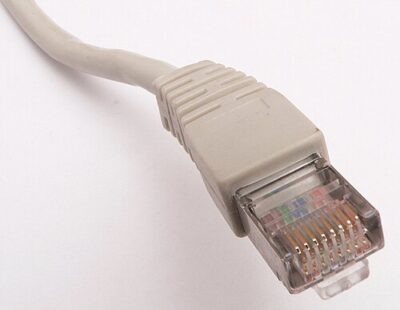
Picture: No machine-readable author provided. David.Monniaux assumed (based on copyright claims)., via Wikimedia Commons · CC BY-SA 3.0