Expedition 1
Expedition 1 is the first long-duration human stay aboard the International Space Station.
All 3 facts, and where they come from
Facts
3 facts · 0 confirmed by two sources · 1 cited · 2 from one source
Where this comes from
Papalocal keeps its own record. It started from these sources; what each one said is kept here as it was copied, so a change on their side never changes this page by itself. Tap one to read its version.
What Wikidata says · copied November 17, 2026 · revision 2558210372
- Described as
- First long-duration human stay aboard the International Space Station
- What it is
- expedition to the International Space Station
- Followed by
- Expedition 2 · 1 reference
- Official website
- http://www.nasa.gov/mission_pages/station/expeditions/expedition01/index.html
- Wikipedias with a page
- 30
Wikidata item Q17181 (wikidata.org/wiki/Q17181), public domain (CC0). Copied 2026-11-17.
What Wikipedia says · copied November 17, 2026 · revision 1369249218
Expedition 1 was the first long-duration expedition to the International Space Station (ISS). The three-person crew stayed aboard the station for 136 days, from 2 November 2000 to 19 March 2001. It was the beginning of an uninterrupted human presence on the station which continues as of 2026.
The official start of the expedition occurred when the crew docked to the station on 2 November 2000, aboard the Russian spacecraft Soyuz TM-31, which had launched on 31 October 2000 at the Baikonur Cosmodrome in Kazakhstan. During their mission, the Expedition 1 crew activated various systems on board the station, unpacked equipment that had been delivered, and hosted three visiting Space Shuttle crews and two uncrewed Russian Progress resupply vehicles. The crew was very busy throughout the mission, which was declared a success.
The three visiting Space Shuttles brought equipment, supplies, and key components of the space station. The first of these, STS-97, docked in early December 2000, and brought the first pair of large U.S. photovoltaic arrays, which increased the station's power capabilities fivefold. The second visiting shuttle mission was STS-98, which was docked in mid-February 2001 and delivered the US$1.4 billion research module Destiny, which increased the mass of the station beyond that of Mir for the first time. Mid-March 2001 saw the final shuttle visit of the expedition, STS-102, whose main purpose was to exchange the Expedition 1 crew with the next three-person long-duration crew, Expedition 2. The expedition ended when Discovery undocked from the station on 18 March 2001.
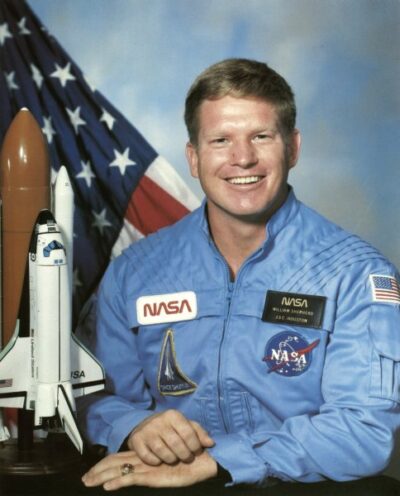
The Expedition 1 crew consisted of an American commander and two Russians. The commander, Bill Shepherd, had been in space three times before, all on shuttle missions which lasted at most a week. The Russians, Yuri Gidzenko and Sergei K. Krikalev, both had previous long-duration spaceflights on Mir, with Krikalev having spent over a year in space.
From the Wikipedia article “Expedition 1” (en.wikipedia.org/wiki/Expedition_1), by its contributors, under CC BY-SA 4.0 (creativecommons.org/licenses/by-sa/4.0/). Copied 2026-11-17; not changed.
Confirmed Two sources agree. Cited One source, and it names where it got it. One source One source, without a reference of its own. Sources disagree The sources disagree. We show the best-supported value and keep theirs below.
Picture: Wikimedia Commons: ISS-Expedition 1-crew.jpg · See Commons file page