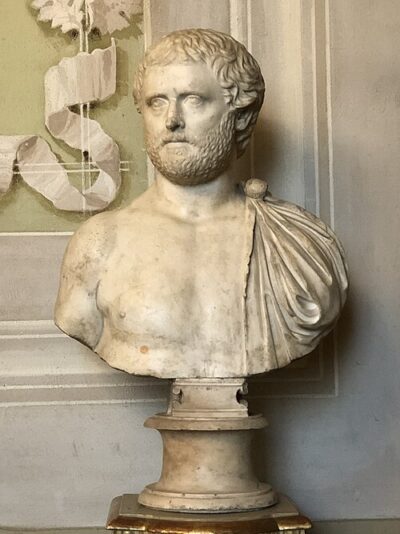
Fasti
Fasti is a Latin poem by Ovid (8 AD).
- Came out
- 8
- Written by
- Ovid
- Genre
- epic poem
- Country of origin
- Roman Empire
All 6 facts, and where they come from
Facts
6 facts · 0 confirmed by two sources · 0 cited · 6 from one source
Where this comes from
Papalocal keeps its own record. It started from these sources; what each one said is kept here as it was copied, so a change on their side never changes this page by itself. Tap one to read its version.
What Wikidata says · copied November 17, 2026 · revision 2565887366
- Described as
- Latin poem by Ovid (8 AD)
- Other names
- Ov. Fast.
- What it is
- literary work
- Written by
- Ovid
- Genre
- epic poem
- Language
- Classical Latin
- Country of origin
- Roman Empire
- Came out
- 8
- Wikipedias with a page
- 27
Wikidata item Q1236235 (wikidata.org/wiki/Q1236235), public domain (CC0). Copied 2026-11-17.
What Wikipedia says · copied November 17, 2026 · revision 1383429058
The Fasti (Latin: Fasti [ˈfaːstiː], "the Calendar"), sometimes translated as The Book of Days or On the Roman Calendar, is a six-book Latin poem written by the Roman poet Ovid and made public in AD 8. Ovid is believed to have left the Fasti incomplete when he was exiled to Tomis by the emperor Augustus in 8 AD. Written in elegiac couplets and drawing on conventions of Greek and Latin didactic poetry, the Fasti is structured as a series of eye-witness reports and interviews by the first-person vates ("poet-prophet" or "bard") with Roman deities, who explain the origins of Roman holidays and associated customs—often with multiple etiologies. The poem is a significant, and in some cases unique, source of fact in studies of religion in ancient Rome. Each book covers one month, January through June, of the Roman calendar, and was written several years after Julius Caesar replaced the old system of Roman time-keeping with what would come to be known as the Julian calendar.
The popularity and reputation of the Fasti has fluctuated more than that of any of Ovid's other works. The poem was widely read in the 15th–18th centuries, and influenced a number of mythological paintings in the tradition of Western art. In 1931, it was translated and annotated by the influential anthropologist and ritualist J.G. Frazer for the Loeb Classical Library series. However, as scholar Carole E. Newlands has observed, throughout the 20th century "anthropologists and students of Roman religion … found it full of errors, an inadequate and unreliable source for Roman cultic practice and belief. Literary critics have generally regarded the Fasti as an artistic failure." In the late 1980s, however, the poem enjoyed a revival of scholarly interest and a subsequent reappraisal; it is now regarded as one of Ovid's major works, and has been published in several new English translations. Ovid was exiled from Rome for his subversive treatment of Augustus, yet the Fasti continues this treatment—which has led to the emergence of an argument in academia for treating the Fasti as a politically weighted work.
From the Wikipedia article “Fasti (poem)” (en.wikipedia.org/wiki/Fasti_(poem)), by its contributors, under CC BY-SA 4.0 (creativecommons.org/licenses/by-sa/4.0/). Copied 2026-11-17; not changed.
Confirmed Two sources agree. Cited One source, and it names where it got it. One source One source, without a reference of its own. Sources disagree The sources disagree. We show the best-supported value and keep theirs below.
Picture: Wikimedia Commons: Ovidio, fasti, toscana 1410 ca. (pluteo 36.23) 01.jpg · See Commons file page