Federal Woman's Award
Federal Woman's Award is a discontinued United States Civil Service Commission award (1961 - 1976).
- Given by
- United States Civil Service Commission
- Country
- United States
- Created
- 1961
All 5 facts, and where they come from
Facts
5 facts · 0 confirmed by two sources · 0 cited · 5 from one source
Where this comes from
Papalocal keeps its own record. It started from these sources; what each one said is kept here as it was copied, so a change on their side never changes this page by itself. Tap one to read its version.
What Wikidata says · copied November 17, 2026 · revision 2505165764
- Described as
- discontinued United States Civil Service Commission award (1961 - 1976)
- What it is
- award
- Created
- 1961
- Ended
- 1976
- Country
- United States
- Given by
- United States Civil Service Commission
- Wikipedias with a page
- 2
Wikidata item Q56273578 (wikidata.org/wiki/Q56273578), public domain (CC0). Copied 2026-11-17.
What Wikipedia says · copied November 17, 2026 · revision 1360730732
The Federal Woman's Award, also known as the Federal Women's Award, was given by the United States Civil Service Commission from 1961 until 1976.
The Federal Woman's Award was established by Barbara Bates Gunderson in 1960, while she was serving on the Civil Service Commission. Her goal was to publicize the ways women were excelling in federal employment, and to encourage young women to consider careers with federal laboratories and agencies. Gunderson was also the first chair of the award's board. Katie Louchheim, Deputy Assistant Secretary of State for Public Affairs, and later Patricia Hitt, Assistant Secretary of Health, Education, and Welfare, issued press releases about the awards and appeared at the presentation events.
Nominations were submitted annually by federal departments and agencies to the board of trustees for the Federal Woman's Award. The nominations were judged by a panel of "persons prominent in public life", including magazine editors, broadcasters, journalists, business executives, and college presidents. Among the judges were Milton S. Eisenhower, Carl Rowan, Doris Fleeson, Arthur Sherwood Flemming, Sol Linowitz, David Brinkley, Betty Furness, and Katharine E. McBride.
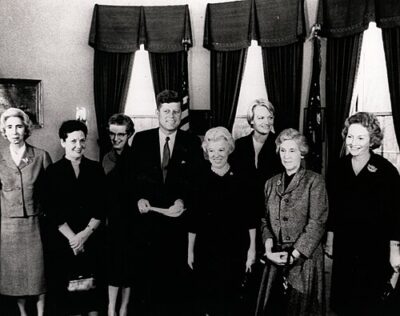
About six recipients were selected each year, for their "outstanding achievement and ability in an executive, professional, scientific, or technical position in the federal service." Award winners were invited to a ceremony in the Oval Office. The president posed for official photographs with the group, and made remarks for the occasion.
The awards were discontinued after the 1976 presentations, though there were nominations for 1977. "Although the prize had served its purpose at no cost to the government, its continuation in the era of equal opportunity as a separate compensatory award for women only, which had seemed so harmless and even chivalric before, began to raise concerns and embarrassment," noted historian of science Margaret Rossiter. In 1978, Rosalyn Yalow, one of the award's first recipients, recalled that "I viewed this award as second-class", adding "I was therefore delighted to learn last year that the Federal Woman's Award was to be discontinued — I hope permanently."
From the Wikipedia article “Federal Woman's Award” (en.wikipedia.org/wiki/Federal_Woman's_Award), by its contributors, under CC BY-SA 4.0 (creativecommons.org/licenses/by-sa/4.0/). Copied 2026-11-17; not changed.
Confirmed Two sources agree. Cited One source, and it names where it got it. One source One source, without a reference of its own. Sources disagree The sources disagree. We show the best-supported value and keep theirs below.
Picture: NASA Hubble Space Telescope, via Wikimedia Commons · Public domain