Feynman checkerboard
Feynman checkerboard is a fermion path integral approach in 1+1 dimensions.
All 1 facts, and where they come from
Facts
1 facts · 0 confirmed by two sources · 0 cited · 1 from one source
Where this comes from
Papalocal keeps its own record. It started from these sources; what each one said is kept here as it was copied, so a change on their side never changes this page by itself. Tap one to read its version.
What Wikidata says · copied November 16, 2026 · revision 2484800564
- Described as
- fermion path integral approach in 1+1 dimensions
- What it is
- physical theory
- Wikipedias with a page
- 4
Wikidata item Q5446134 (wikidata.org/wiki/Q5446134), public domain (CC0). Copied 2026-11-16.
What Wikipedia says · copied November 16, 2026 · revision 1233801895
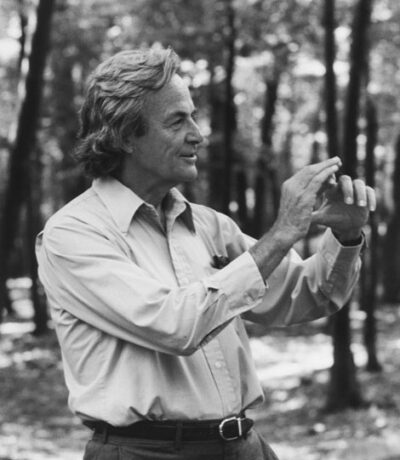
The Feynman checkerboard, or relativistic chessboard model, was Richard Feynman's sum-over-paths formulation of the kernel for a free spin-1/2 particle moving in one spatial dimension. It provides a representation of solutions of the Dirac equation in (1+1)-dimensional spacetime as discrete sums.
The model can be visualised by considering relativistic random walks on a two-dimensional spacetime checkerboard. At each discrete timestep ϵ the particle of mass m moves a distance ϵc to the left or right (c being the speed of light). For such a discrete motion, the Feynman path integral reduces to a sum over the possible paths. Feynman demonstrated that if each "turn" (change of moving from left to right or conversely) of the space–time path is weighted by −iϵmc2/ℏ (with ℏ denoting the reduced Planck constant), in the limit of infinitely small checkerboard squares the sum of all weighted paths yields a propagator that satisfies the one-dimensional Dirac equation. As a result, helicity (the one-dimensional equivalent of spin) is obtained from a simple cellular-automata-type rule.
The checkerboard model is important because it connects aspects of spin and chirality with propagation in spacetime and is the only sum-over-path formulation in which quantum phase is discrete at the level of the paths, taking only values corresponding to the 4th roots of unity.
From the Wikipedia article “Feynman checkerboard” (en.wikipedia.org/wiki/Feynman_checkerboard), by its contributors, under CC BY-SA 4.0 (creativecommons.org/licenses/by-sa/4.0/). Copied 2026-11-16; not changed.
Confirmed Two sources agree. Cited One source, and it names where it got it. One source One source, without a reference of its own. Sources disagree The sources disagree. We show the best-supported value and keep theirs below.